Sunday, September 13, 2015

Birthday Musings


The birthday greetings especially in an era of social networking and powerful tool Facebook would leave any individual moved. The greetings came in from all corners – including from across the border in Pakistan. The occasion, otherwise very normal in a very ordinary career and life, became momentous. Thus a big Thank You to all!!


Parents, daughter Tinni among others
On such occasions, one also feels like looking back. I look back in gratitude to my parents and some individuals – friends, teachers and professional colleagues. I have stated earlier in these blogs, hundreds of people have helped me build my life and career. They are of course, not responsible in any way, for the person and journalist I have turned out to be, particularly for the negative straits. 

With parents, my life largely remained formal and it was only with my brother Nirmal Kumar Deb that I could open up. It was he, who first knew about my first love – Journalism and he would reciprocate in awful voice – ‘Jis rah chuni tuni us raste pe chalta jana rey…

But the charismatic Naga lady Chipeni Merry is one exception who should get some credit for little of what I have achieved for myself. She was always a good-humuored soul ready to befriend. Our friendship just clicked, something that would defy definitions and reasons. 
A class mate of my English lecturer, Chipeni Merry has been the best of the lot. On one occasion I confided in her about my parental pressure and that I was planning to quit Nagaland; she immediately screamed that I was wrong. Journalism for a non-Naga in Nagaland was a risky game in 1990s. 
Chipeni promised me that I should not fear anything or anybody. That I would be constantly tailed by her. 
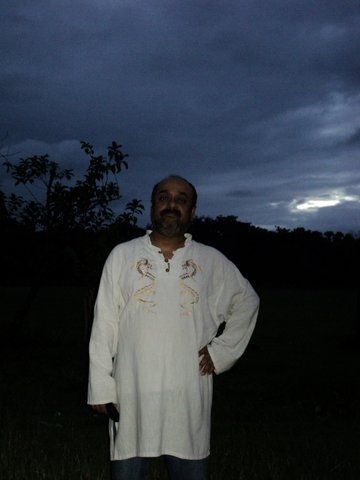
Birthday Boy!!
But once she realized I should move out, Chipeni would scream rudely, “You rot here”. Not surprisingly, when I had to rush to Delhi from Kohima for interview with PTI on a very short notice, it was she yet again who handed over Rs 5000 to her cash-starved friend. 
One can never repay such friends!
If I am over stating over my stay in Nagaland; I must add here: it’s been a wonderful experience to be brought up in north east – Nagas, Mizos (three years) and Khasis and Garos in Meghalaya in adolescent period. 
These brought a change in mind that at later period, my father would taunt me, “you think like a Naga”.

As I often felt and even dreamt like a Naga, I developed a liking for them – the way they look at things! The food – pork with bamboo shoot.
But it goes without saying that the veiled influence of Bengali middle class and conservative parents and an indulgent grand mom too shaped my value system and thoughts.
Then came in journalism – more as an accident and an accidental love – aftermath my failure with initial flirtation with science.
A true friend: Chipeni - Chips in the centre

Journalism gave me some wings. I found it different. 
Here I was exposed to more than the normal quote of philosophy or moral teachings of a conservative Bengali family!!
Journalism enhanced my confidence- the bedrock of which was laid at Springdale School, Lunglei (a border town in remote Mizoram) --- where I befriended Mizo damsels like Evelin and Zoramthangi. Then came St Anthony’s High School, Shillong, also a new experience staying away from parents.

I have seen the FUN days of journalism.
But as most of you know, journalism too is like a stream where our very society is the source. As is the source, so will be the stream! We have black sheep, and more so in the post-liberalism era. Sadly, I often wonder - Does this post-liberalism era have a direct connection with materialistic richness and greed? 
Shillong's Don Bosco Square: Alma mater St Anthony's

Saturday, September 12, 2015

Of PAC powers over CAG - Answer lies in the womb of time


The government's policies are often tailored for the greedy, paid for by the needy!!

This blog is in continuation of the last piece ‘Who will control CAG of India? What's the game all about?'
The provocation is surprisingly from the patrons of the blog who have read and reacted overwhelmingly – with most comments figuring on the Facebook pages.
Among them two - very good friends and sincere and objective critics – Varadarajan Krishnamurthy, a senior colleague in the fraternity and the other Prashant Pandey, a young friend – now operating from the holy city Allahabad, raised some obvious questions and also given an impression that the present Modi regime wants to ensure that there are not much adverse reports when it is a few years old. 
After all, the previous government did try to reject the CAG's figures by going for the "zero loss" theory. 


One Varadarajan Krishnamurthy,  a former journalist with The Hindu Businessline, wrote on Facebook, “the entire thing is little confusing. How is the new demand different from the prevalent status of CAG.  It's reports are submitted to the Parliament as well …Would like to be enlightened”.
Prashant took the trouble of sharing his comments on the blog page itself saying,
“to say that CAG is not accountable to Parliament misses me (read Prashant)....Is it the case that they want CAG to report to Parliament, which would then dilute its autonomous status?
I am no expert on constitutional mechanism like Comptroller and Auditor General of India (CAG) or the Public Accounts Committee (PAC) of Parliament and the state legislatures.

But at the same time, I thought, it would not be prudent to ignore their comments completely as they as sincere readers of my blogs – expected me to answer few questions. Hence this humble attempt!
Are we in a situation of a conflict between constitutional authorities like the CAG and the government or Parliament?
I have no snake oil which can be used as having a magical healing power in settling the matters.

Almost echoing similar sentiments, others have asked, “is there an attempt to make the CAG "go soft" on the present government headed by Prime Minister Narendra Modi?”
These questions are valid, I presume.
The reference about CAG-PAC equations did not come out of the blue.

In fact on the inaugural address, none other than the Lok Sabha Speaker Sumitra Mahajan had laid down a certain road map.

Dwelling on the important role of the CAG and the PAC, she said “CAG and PAC together deal with the three ‘A’s- Accounts, Audit and Accountability.  They audit the Accounts of Government Departments to fix accountability. I would expect, if possible, another ‘A’ will be added to this in the form of ‘Appreciation’ wherever  due, so that innovative good practices and projects can be replicated elsewhere”.

In fact, among prominent issues those figured in the agenda list to be discussed included, “PAC-C&AG equation, where discussions will be held on the complimentary and supplementary role the two institutions have in ensuring and enhancing public financial accountability in the country”.

But the real debate is on the appointment of CAG. Today it is absolute discretion of the government of the day and thus when UPA regime appointed a former Defence Secretary Shashi Kant Sharma, then opposition BJP raised hue and cry.

CAG dispute: UPA Vs Modi regime

The present Finance Minister Arun Jaitley, then LoP Rajya Sabha, had said he was not making remark about the individual but it was an "institutional conflict of interest".
"He will audit it himself. Is it appropriate?" Jaitley had asked.
"The policy of the UPA has been callous disregard of all democratic institutions. The quality of appointments made to constitutional and statutory offices establishes that the policy of the government is to subvert these institutions," Jaitley and Sushma Swaraj had said in a joint statement.

However, the debate is not new. In June 2012, one year before Shashi Kant Sharma was appointed CAG, the BJP patriarch L K Advani had suggested that CAG's appointment should be made by a bipartisan collegium consisting of the Prime Minister, the Chief Justice, the Law Minister and the Leaders of the Opposition in Lok Sabha and Rajya Sabha. Interestingly, DMK chief then an ally of Congress, M Karunanidhi had supported Advani’s demand.

CPI leader Gurudas Dasgupta wrote a letter to the PM Dr Manmohan Singh in June 2012 suggesting that the CAG be appointed by the collegium consisting the PM,the CJI and the leader of the opposition in Lok Sabha. But Dr Manmohan Singh had turned down the demand saying there was no urgent need for any such change.
Dr MMS with Madam's approval said 'No Change'
Now what’s the PAC chairpersons’ conclave has tried to achieve. Essentially they want the PAC chairmen are consulted for the appointments. And this is nothing unusual in terms of happening in other countries practicing parliamentary democracies.

In United Kingdom, the Comptroller and Auditor General appointment is made by the Prime Minister “acting with the agreement” of the Chairman of the Committee of Public Accounts. In Australia, the Governor General appoints the Auditor General on the recommendation of the Minister concerned after the Minister has referred his recommendation for approval of the Joint Committee of Public Accounts and Audit. Similar practice is pursued in Germany also. 
"The CAG of India is not accountable today even for lapses and certain irregularities it commits in its audit report itself," says BJP MP Nishikant Dubey. Did u all notice, for a change a BJP lawmaker is talking like Digvijaya Singh !
(ends) 

Wednesday, September 9, 2015

Who will control CAG of India? What's the game all about?


In a move that could spark off a major debate on 'attempts' to dilute the powers of the Comptroller and Auditor General (CAG) of India vis-a-vis the powers of Parliament and the government, the two-day long conference of chairpersons of Public Accounts Committees (PACs) recommended immediate amendments to the CAG Act of 1971 so that the country's high-profile chief auditor be made accountable to the legislature.
"The CAG of India is not accountable today even for lapses and certain irregularities it commits in its audit report itself," BJP MP Nishikant Dubey said in presence of chairman of Parliament's PAC, Prof K V Thomas. 
The two leaders were talking to media after two-day conference of chairpersons of Public Accounts Committees of parliament and state legislatures. What’s the entire game all about? Who really wants to control CAG?

The reference about CAG-PAC equations did not come out of the blue. In fact on the inaugural address, none other than the Lok Sabha Speaker Sumitra Mahajan had laid down certain roadmap when she had said, discussions could happen on "complimentary and supplementary" role of the two institutions.  

Just a few years back, we had a completely different story. The CAG was supposed to be most credible institution in the country and its findings RS 1.76 lakh crore loss due to scam in 2G scam and later Rs 1.86 lakh crore coal block allocation irregularities were taken as Gospel’s truth!
The backgrounder of course is, that the fungus of corruption had “eaten into all spheres of life” in India and the country was made to believe it’s the CAG which will tame the wrong doers. Coincidentally, the Congress fell prey to the machinations!
The general belief was that the Comptroller and Auditor General of India is the new institute which would bite the slice of the cake and display certain neo-activism. The auditor’s report on Commonwealth Games and others for the first time pointed fingers squarely at the PMO, ironically then run by economist-PM who was also credited for so called ‘honesty’.
Now the game seemed to have changed!
Blogger in Parliament corridors
"During 15th Lok Sabha a suggestion was made by the then PAC that the CAG should be part of legislature
in U.K and Australia," BJP MP Nishikant Dubey said adding the issue figured in the two-day conference convened by Lok Sabha. The conference of chairpersons of PACs was held for the first time after 14 years.
So was it just a formality or a real meeting of minds – where the PAC chiefs sought to give unto themselves more power, more teeth and make governments more accountable to the panel(s).

Prof Thomas said nearly 20 points on issues of powers and jurisdictions of PACs figured during the two-day deliberations and a sub-committee headed by Nishikant Dubey (BJP) will study the suggestions and observations made in the meeting to make appropriate recommendations to the concerned authorities including the President, the Prime Minister and the Lok Sabha Speaker.
The panel comprises of other members like B Mahtab (BJD) and Bhubeneshwar Kalita (Congress).

"This panel will examine all issues involved and likely to recommend amendments in the CAG Act of 1971to bring the auditor under the jurisdiction of Parliament," Dubey said.

The PAC headed by Dr Murli Manohor Joshi in 15th Lok Sabha had recommended that the PAC be consulted by the government before the appointment of the CAG.
"The need for complete independence of the CAG making it a part of PAC would add to the harmonious relations between CAG and the PAC," Dubey said adding the sub-committee will make its recommendations by the end of the financial year 2015-16.
Parliament's new power structure
Asked whether such a move would not dilute the autonomous powers of the CAG, an issue that had figured aftermath CAG reports on spectrum allotment and coal blocks allocation had rocked the UPA dispensation, Dubey replied in negative.
"Where is the question of dilution of CAG's powers. The CAG will be only made accountable to the legislature that is Parliament of India and not to any one individual or the institution," Dubey said.

Prof Thomas said during the two-day deliberations, PAC chairpersons from across the country suggested among other things that the panel deliberations should be "open to media except in sensitive cases".
"The PAC should henceforth also take up examination of expenditures made for Public Private Partnership projects and PAC take suo motu cognizance of issues and also audit the functioning of NGOs," Thomas said.

The Committee on Public Accounts, more popular as PAC, is a permanent body and is constituted by Parliament each year for examination of accounts showing the appropriation of sums granted by Parliament for expenditure of Government of India. This PAC is incidentally the oldest Parliamentary Committee and was first constituted in 1921.  The Committee consists of 22 Members, 15 members from Lok Sabha and 7 from the Rajya Sabha. 
The rule book says, the Speaker is empowered to appoint the Chairman of PAC from amongst its members; but the by convention the chairmanship of PAC is being given to the principal opposition party. 

Tuesday, September 8, 2015

Islamophobia in Assam - Fear and Faith

The Hindu-Muslim relationship and the much talked about rights of religious minorities are the flavour of the season. To top it all has been the release of Population by Religious Communities of Census 2011. Keeping in mind the crucial Bihar elections, the timing of the release of data that was with the government since the time of UPA dispensation is curious. In the context of Assam, the latest data has renewed the controversy in a state that has witnessed political upheavals and violence in the name of demographic growth and imbalances.
Assam’s Muslim population has increased to 34.22 per cent, a quantum leap of over four per cent, while the Hindu population has been around 61.46 per cent. Statistics often conceal more than what they reveal. But for people of Assam, these census figures will be like hot potato politically as elections are due early next year. The regional Asom Gana Parishad and the BJP would be plunging in as at least three new prominent districts in the state now shown a sharp rise in the Muslim population.

In 2001, six districts in Assam were Muslim dominated, but in 2011 it increased to nine. The Muslim majority districts include Barpeta, Dhubri, Karimganj, Goalpara, Darrang, Bongaigaon, Hailakandi, Nagaon and Morigaon.

In Assam, this demographic transition in some pockets — closer to the international border with Bangladesh and some even away from the border — would certainly yet again spark off the debate over the Bangladeshi influx. Nevertheless, it should be kept in mind that in the 1970s during the peak of the students’ agitation, the initial “anti-foreigner” agitation against the influx of Bangladeshis got embroiled in the “Bongali kheda”’ (chase out Bengali) campaign. Even Hindu Bengalis were at times at the receiving end of the local anguish.
Even in 2012, Assam witnessed a bloodbath owing to conflicts of interest between Bodo tribals and Bengali Muslims. The clashes and subsequent remarks from politicians — especially the likes of Hyderabad-based Asaduddin Owaisi, who lately expanded his base in Maharashtra too — aroused passions and undoubtedly created the upsurge for a violent protest in Mumbai. The Mumbai hara-kiri and lopsided handling of the entire situation primarily due to police complicity and the then Congress-NCP regime in Maharashtra actually accentuated the unprecedented exodus of North-east people from hubs like Mumbai, Pune and Bangalore.
Those who propose to rake up “Muslim population increase” in Assam now in the run-up to the 2016 assembly elections should also remember that the genesis of the insane rage in Bodotribal pockets in 2012 also owed its origin to population arithmetic. There has been an interesting and perhaps funny angle to some of the statistical figures those were reported then. 
It was said only in 2011, in Kokrajhar and neighbouring districts, that the Muslim population was counted at about 235,000, but by June-July 2012 Badruddin Ajmal, chief of the pro-Muslim All India United Democratic Front championing the cause of minorities, said about 500,000 Muslims were in relief camps. So the obvious question was: from where did so many Muslims come so fast?
Even then, Union home minister P Chidambaram admitted that illegal immigration had been one major issue that got lost in the din. That’s the paradox of North-east India. Forwarding the clock to 2015, let us revisit the official data now released by the Census authorities. The Muslim population has increased by 28.8 percentage points in Darrang district, 14.88 points in Kamrup, 13.86 points in Nalbari and 11.37 points in Barpeta. Interestingly, in districts bordering Bangladesh, Dhubri saw a rise of 5.67 points and Karimganj 4.08 points. So does this imply — as Muslims are growing in numbers in districts away from the international border — that there’s a decline in the Bangladeshi influx?
This could be a fallacy as studies reveal Bengali Muslims, and that should include substantial Bangladeshis, have increased in states like Kerala, too. This school of thought maintains that Muslims who do continue to come from Bangladesh “move” on to other states — even outside the North- east region — for employment.

Monday, September 7, 2015

Limitations of Constitutional mechanism - A Book Review

Book Review on
Troubled Diversity: The Political process in Northeast India
(Edited by Sandhya Goswami)


Bertrand Russel is not much in fashion these days. But the observation he made perhaps for his own life decades back that things happening ‘out of doors’ have made deeper impression than things those have happened ‘indoors’ could be somehow relevant for northeast India. The region is certainly trapped in myriads of conflicts. One diagnosis has been well articulated in the foreword of this book, ‘Troubled Diversity: The Political process in Northeast India’. 
Late D P Barooah, the former Vice Chancellor of Gauhati University eloquently wrote in the foreword, “it is a patent reality that the political leadership committed grave errors over the years in confounding political problems and then sought to deal with them militarily”.
The compendium edited by educationist Sandhya Goswami has tried to take both holistic and issue-based approach in understanding the problems of the region and unraveling the multiple layered in most of them. Here comes the relevance of Russel’s observation on happenings ‘out of doors’. Those who follow northeast India also know that there exists a skewed perception of development and that’s the obvious fact that development has been prone to politicization and something delivered ‘externally’ from New Delhi.

Here comes the relevance of this book as it seeks to highlight different facets of the region and the people. Some candid speaking in the volume are based on the ear-on-ground studies as essays by researchers, scholars and northeast watchers are compartmentalized in three sections – first, Historical Legacies, followed by Diversity, Development, Conflict and Management and thirdly, a crucial Comparative Perspective between the northeast and another trouble-torn state of Jammu and Kashmir.

The tendency of policy makers and even academicians so far used to be to try to understand the northeast India – seven sister states of Assam, Arunachal Pradesh, Meghalaya, Manipur, Mizoram, Nagaland and Tripura along with a new member Sikkim – as a vast land often ungovernable in more ways than one. This is true. However, there’s another salient feature that while some pockets in the region have suffered violence and killings over the years as cursed hamlets, seldom any study has tried to focus on various segments of people – especially the often neglected ones like tea garden labour force.
Therefore the second section of the book dealing with smaller tribes like Karbis, Dimasas, Tea-tribes and the bigger issues of autonomy and local governance paradox is certainly a prized take away from the compendium.
Dimasa damsels
Jayanta Krishna Sarmah from the Department of Political Science, Gauhati University, does well to pin point that the complex challenge of demography should be the key to understanding the dynamics of various tribal and ethnic movements. “Different ethnic communities with distinct languages, histories and traditions have demanded recognition and support for their cultural identity,” Sarmah says aptly.   
In the process, northeast India today notwithstanding the media-hyped ‘freedom’ movement of Nagas, Mizos and various outfits in Assam and Manipur, have as many as 10 autonomous councils under the Sixth Schedule of the Constitution.

But as we look back, problems still persist and public grievances punctuated with anti-India and anti-administration sentiments still make tough for the governments both at the respective state level and for the centre in New Delhi. 

Do all these only expose the limitations of constitutional mechanism to resolve some of the problems of the northeast India? One has often heard constitutional experts and babus describing the Sixth Schedule as a ‘constitution within the Constitution of India’. This provides for special political arrangements for ethnic minorities as a means for devolution of power. 
But there are issues and thus, it can be safely stated that there can be no better example of the phrase – wheels-within-wheels! That makes understanding northest of India a fairly tough challenge.
This is precisely the story of the long-neglected and over-exploited ‘Adivasis’ of Assam. The roots of Adivasi identity in Assam is submerged in the history of the growth of the tea industry, a sector that has made both Assam and northeastern region proud. 

But it would be also pertinent to point out that the conferring of constitutional benefits in terms of inclusion of a group in the list of Scheduled Caste (SC) and Scheduled Tribe (ST) or Other Backward Class (OBC) over the years – especially in the context of northeast - has depended largely on the level of socio-economic backwardness and also on the strength of demand articulation.
Have we heard, ‘New Delhi fears violence’ – more as a refrain?

One feels the book should have dealt a bit more on these questions as the contributors to the volume are academicians per se and thus are less guided by the safety perimeters of bureaucrats (or former bureaucrats) or prejudices of journalists and politicians.

The third section – the comparison between northeast India and Jammu and Kashmir - is again a debatable paradox. 

One is raising the absurdity bogey largely because for a study like this considering northeast as a whole unit vis-à-vis the problems in Kashmir are erroneous even theoretically.

The problems in each of northeastern states are distinctly different and peculiar and thus a more worthwhile comparative study between Jammu and Kashmir would have been to take one or two states from the region. The attempt made by Noor Ahmed Baba in his paper ‘Northeast and Kashmir’ to draw a parallelism that the Indian federalism and constitutional mechanism has had problems with “peripheral regions” (i.e Jammu and Kashmir and Northeast) is actually a too far-fetched argument.

One cannot discard the issue of corruption and leakage but the internal political and administrative forces in these suppose ‘peripheral regions’ cannot be given clean chits so easily either.

Friday, September 4, 2015

Teachers’ Day, 2015 – A Memento of memories


India has created a new record, and a good one. Incidentally chief protagonists are two time-tested politicians! Both the Prime Minister Narendra Modi and the President Pranab Mukherjee addressed and interacted with the students and the events were obviously telecast live on national television as also the private channels.

The occasion was on-the-eve-of birth anniversary (Sept 4) of country’s illustrious President Dr Sarvepalli Radhakrishnan. Going by conventions of protocol and rightly so, first Prime Minister Modi took the floor and shortly after Modi interacted with nearly 800 students from nine states, - Manipur to Karnataka- President Pranab Mukherjee himself turned teacher and taught school students about the country's political history.
Art of Choreography: Statesmanship
Venues were miles apart and the choreography - even if it was not there - seemed to have gone well!
Both had their homework done pretty well and in display of smooth coordination between two top executives in country’s polity, PM Modi and Prez Mukherjee almost had their speech compartmentalized.
While Modi with a typical neta characteristic dwelt at length on enumerating future promises, Pranab Mukherjee stuck to his statesman-type mannerism and dealt on the past trying to ignite the young minds towards nation building and the cherished cause of democracy.

To start with, President Mukherjee, a man with good memories, explained about the creation of the Constitution that gave Indian people power to make their own laws.

A creation of Congress school of politics, the President pointed out how Democracy was nurtured and how Democracy gives opportunity to the common people to fulfill their aspirations. In this context, he pointed out how several countries who emerged as independent nations from Pakistan, Indonesia and Sri Lanka, and how they failed to keep up parliamentary democracy. He mentioned about Jawaharlal Nehru, Mahatma Gandhi and Dadabhai Naoroji as also P V Narasimha Rao, who incidentally did not get his due from his Congress party itself. 
The State of affairs in Education


“The establishment of multi-party democratic system with Parliamentary form of government was an important event,” Pranab da said.

On March 11, 2015, I was among the select group of journalists who called on Pranab Mukherjee for an informal interaction over high tea. On that occasion too, he made a brilliant speech – extempore and referring to historical dates and anecdotes flawlessly.
Often dubbed in the media as a five-foot nothing, Pranab Mukherjee is always a pleasure to listen to and educative too. Students of Dr Rajendra Prasad Sarvodaya Vidyalaya located in the sprawling President's Estate, however missed a glimpse of Pranabda’s famous short temper – we working journalists often were blessed with. On one occasion when economy under UPA-2 was going doldrums and Congress had committed to creation to Telangana, our beloved President almost shut the door of his car on my face and the verbal rebuke, I must say, would be cherished!
For his part, Namo had his show well organized as he beamed sitting amidst his ministerial colleagues, Smriti Irani, Upendra Khushwaha (despite tension of allies pressure in Bihar polls) and Jayant Sinha. 
Blogger with Pranabda
At least my wife thought Modi put up a better show ! Mind you, the Tripura lady is a daughter of a late Marxist comrade from Manik Sarkar’s state!
“People who have done well in their career should at least spend one hour per week or 100 hours in a year to teach students,” Modi said exhorting every individual to pass on his or her knowledge. But Modi’s classic oneliner and an election winner-type was:  Maa..janam deti hae.......Guru Jeevan deta hae.
(Mother gives you birth but it is the teacher/Guru who makes your life)”.
What about their back pain?

Thursday, September 3, 2015

Cruising Towards Peace: Amid myriad Challenges


Over the last few decades the North-east has been witness to ethnic, political and combined insurgencies and through it all the occasional peace talks have resulted in a puzzling enigma for both sides. Thus, whenever a peace initiate to quell state-level insurgency seems to make progress, one realises these parleys are doomed to spin on because of the political dogma involved. 
Now the Centre has claimed to have made progress in the Naga peace talks with the 3 August signing of a probable solution, even as several questions beg answers.
Significantly, optimism should guide the future turn of events.


In this context, what remains to be scrutinised is that the Modi government is also pursuing peace talks with other militant groups like the National Liberation Front of Tripura and the Ulfa. Talks with the latter began during the UPA regime in February 2011 and, like the Naga dialogue, the process has been slow and halting. Unlike negotiations with the NSCN(IM) leadership, which enjoyed favourable going since 2011, a lot needs to be done with regard to dealing with the Ulfa. New Delhi is talking to only those leaders who surrendered in 2009. 

The Ulfa (Independent) breakaway faction led by self-styled commander-in-chief Paresh Barua, which is now in league with the Khaplang faction of the NSCN, is yet to come forward. A backroom channel was recently opened and spiritual guru Sri Sri Ravishankar had a telephone conversation with Baruah.
The latter was quoted by the local press as having said, “The spiritual leader requested that we should come for talks for an amicable solution to build India. He told me he would help facilitate talks with the government of India. But I told him categorically that talks can be possible only if Delhi agrees to include sovereignty in the agenda.”
For its part, the Centre has reason to welcome Ravishankar’s initiative to “break the ice”. This is perhaps for the first time in last few years that Baruah has spoken to “someone who urged him to accept the inevitability of peace”, according to Intelligence sources in Delhi.
Ulfa peace negotiator PC Haldar, a former Intelligence Bureau chief, has been told to keep the Union home ministry abreast of the developments of his talks with the Ulfa faction led by chairman Arabinda Rajkhowa. The latter has demanded Scheduled Tribes status for Koch-Rajbongshis, Morans, Muttocks, Tai Ahoms and tea tribes. Scheduled Tribe status for these communities is also being linked to next year’s Assam polls as this could give BJP prospects a big boost.
On the other hand, formal parleys with the NLFT are in the offing with Central agencies having cleared the decks in coordination with the Tripura government’s Tribal Welfare Department. The Marxist government headed by Manik Sarkar and the Centre believe the time is “ripe” to drag the NLFT to the negotiating table as the outfit, with a “reduced strength of less than 100”, is in no position to bargain with the government. The hold of Biswamohan Debbarma, a first generation NLFT leader, is already on the wane and the group is now being led by Sachindra Debbarma.
Security specialists say the Modi government is preparing a plan even though most of these negotiations to end insurgency in the North-east are considered “business as usual”. The Prime Minister, they say, appreciates the clamour for peace and thus wants to deliver on this front. 
Regional leaders like Manik Sarkar are cooperating.