Friday, January 29, 2021

How long will India celebrate its secular constitution?

With Indian polity increasingly focusing on Hindu cultural nationalism, is the secular constitution under threat ? 

Are common people really happy under the Modi administration? Various sections of people, including religious minorities and farmers and teachers in some states, are unhappy with the way things are progressing. Still, an independent media survey by India Today said nearly 72 percent of Indians are happy with the government of Modi, whose policies, of course, have been largely revolving around building up a Hindu-only nation.

It is 72 years since India promulgated its secular-democratic constitution. The nation observed the anniversary on Jan. 26, just as in previous years, with a military parade in New Delhi. But an uneasy disquiet continues across the country. 

 Over the years, the parade added cultural tableaux from its provinces. Uttar Pradesh state's cultural tableau this year displayed the model of the Ram temple being built in Ayodhya town at a spot where an ancient mosque stood until 1992 when Hindu radicals demolished it. 

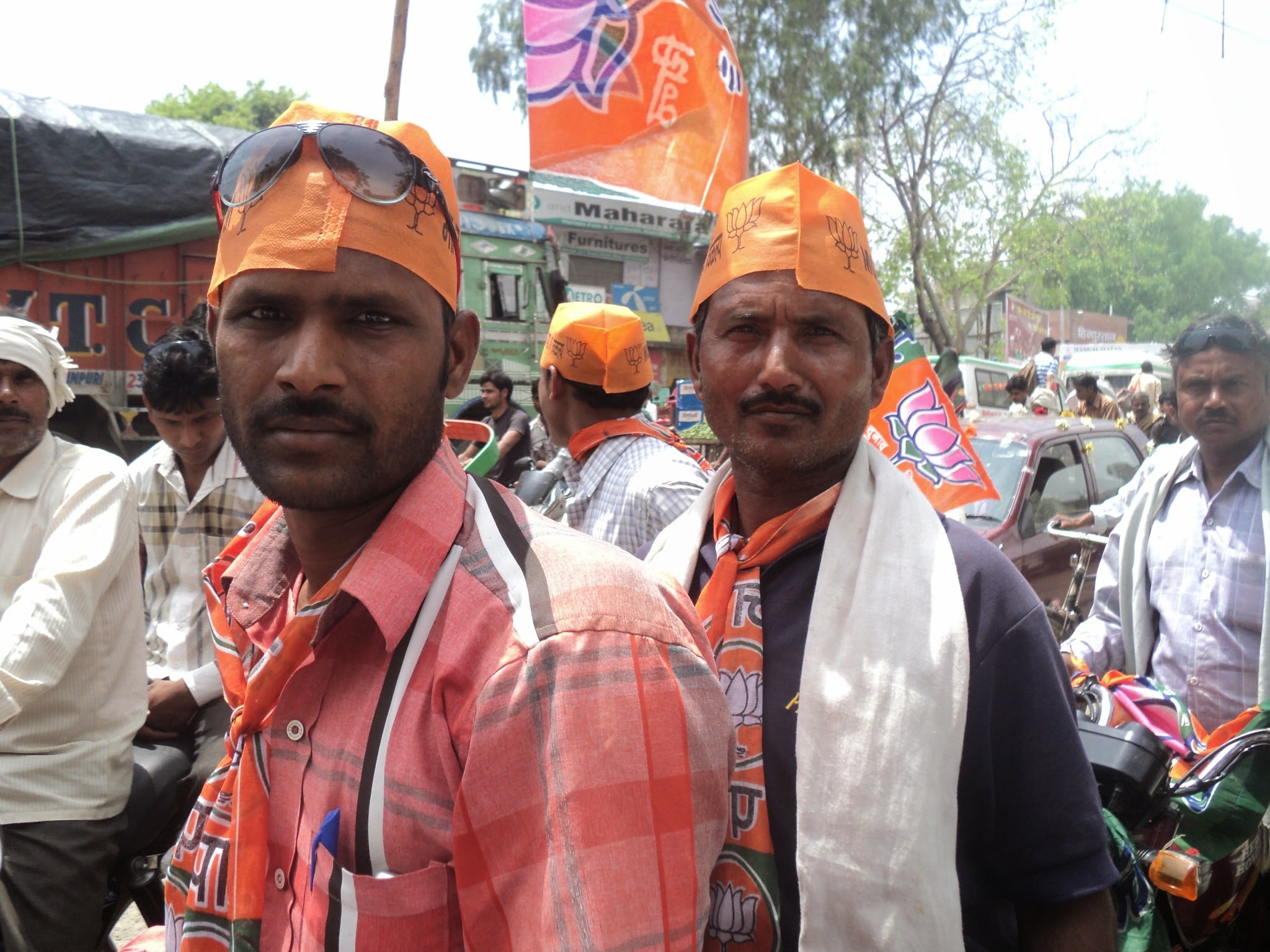
The temple has political connotations for Prime Minister Narendra Modi's Bharatiya Janata Party (BJP), which has vowed to turn India into a nation of Hindu hegemony. The pro-Hindu party came to the national mainstream promising the temple in Ayodhya, their Hindu Lord Ram's birthplace.


Almost three decades after the demolition of the mosque, a major BJP promise is getting fulfilled. The government proudly displayed it at the parade celebrating the anniversary of the nation's secular constitution. That's the growth of Indian democracy! True to the character of any democracy, there is a paradox in India's polity today. While the Modi government returned to power in 2019 with an enhanced mandate and his BJP winning provincial polls, the country is gradually turning into a grieving and protesting nation.

However, the government's performance has done little to create jobs and ensure overall calm, amity and harmony. For the last two years, protests have been  happening around important national days.

During the last Republic Day, it was agitation against the Citizenship Amendment Act (CAA), which is perceived to be discriminating against Muslims. This time the angry lot are the farmers.

Farmers across India are on the warpath against the government's three contentious farm laws. Thousands of farmers from two agrarian states — Punjab and Haryana — have been demonstrating near New Delhi since Nov. 26.

The protesting farmers laid siege to the national capital in a violent show of strength. The riot killed a farmer and injured more than 100 police personnel. Delhi police permitted farmers to have a tractor rally on Republic Day but the protesters deviated from permitted routes and sensitive places including the iconic Red Fort. Police resistance turned them violent.


The government enacted new farming laws in September 2020, purportedly to reform the sector. But farmers and opposition leaders say the laws are meant to help big companies exploit the poor and should be repealed. The violence came after several rounds of negotiations between the government and the agitating farmers' bodies had failed. 


The farmers' rally on Republic Day also highlighted a darker side of Indian politics and governance. At least 60 widows of farmers who committed suicide in Maharashtra participated in the agitation.

According to government data, an average of 14,000 farmers committed suicide each year between 1995 and 2015 to escape debt and poverty because of farm failures. Modi's government came to power in 2014 promising action to help farmers, but since 2015 it has stopped publishing the data about farmer suicides. That's an effective way to tackle the issue in a democracy!

In some states, even teachers are unhappy. In the northeastern state of Tripura, thousands of "dismissed" teachers have protested for the last two months after a court verdict rendered some 10,000 jobless. Several tribal teachers, including some Christians, have committed suicide out of desperation.

Bhagaban Das, a BJP lawmaker, said the teachers should not blame the government. He said the state's former communist government appointed them through a faulty policy and a Supreme Court order nullified the appointments.

"The protests against the BJP are politically motivated as opposition parties feel threatened by the good performance of the Modi government," he maintained.

Others say the BJP leadership is indifferent to people's agony as Modi wants to establish dictatorial rule. It is palpable that the rise of Hindu nationalism in the six years since Modi came to power has left Indian Muslims and Christians nervous and worried.

The main apprehension among religious minority leaders and a section of left-liberals has been that the BJP could change the constitution to discard its secular character and the parliamentary system. This fear is not new.


In the 1990s, Modi's mentor and veteran BJP leader L.K. Advani, a former deputy prime minister, floated the idea of a presidential form of government. Advani said the Indian constitution required a "fresh look." The new Modi regime has been functioning more in a presidential form where Modi is the ultimate and only boss.


There has been a raging debate over allegations that the government has made subtle attempts to subvert constitutional bodies such as the poll panel and Supreme Court to meet its ends.

The government has pursued such an agenda, and on Aug. 5, 2019, it abrogated Article 370 of the constitution that gave guaranteed autonomy to Muslim-majority Jammu and Kashmir state.

In November 2019, the Supreme Court gave a mandate allowing the temple construction in Ayodhya, a move that certainly displeased Muslims.

BJP leaders in their election campaign always include temple visits and public prayers, accusing opposition parties and critics of being anti-Hindu. That has also resulted in Congress and other opposition leaders visiting temples, putting up a show for the media. The evaluation of secularism in India!

As political history progresses in India, the major question is this: how long will India's secular constitution remain intact, guaranteeing freedom of religion and expression to all citizens. That causes disquiet in many Indian minds.

(UCAN News, Jan 27, 2021)

Congress and other opposition leaders including likes of Mamata Banerjee visiting temples to put on a show for the media. 


Many say often Indian communists have shown tendency to play up religious card to woo voters. Notwithstanding protest, the Modi Government's grip on Indian politics remains undiluted.

ends 

Master strategist Modi woos Indian Christians by meeting cardinals

New Delhi witnessed vintage politics when Prime Minister Narendra Modi met three Indian cardinals this week, but it went off more as a photo opportunity without any debated content.

For Modi and his pro-Hindu Bharatiya Janata Party (BJP), the Jan. 19 meeting was a sure piece of material to woo Christians in some key states where elections are due this summer.

At face value, Modi inviting and having an exclusive meeting with India's most senior Catholic leaders — Cardinal Oswald Gracias of the Latin-rite Church, Cardinal George Alencherry, major archbishop of the Syro-Malabar Church, and Cardinal Baselios Cleemis of the Syro-Malankara Church — denotes Modi and the BJP re-establishing strong links with Christians.

The BJP and Modi have been facing criticism for ignoring Christian interests amid reports of increased anti-Christian violence and harassment from Hindu fanatic elements, particularly in northern India.  

The meeting’s timing can easily link it to the fast-approaching state elections in the southern state of Kerala, where Christians are important stakeholders.


Numerically, Christians form some 18 percent of the state’s 33 million people. But in several constituencies, they are strong enough to turn the tables in favor of the BJP, which currently has only one seat in the 140-seat legislative house.


Hindus in Kerala, who form 55 percent of the state's population, have mostly voted for either left-wing parties or the BJP's national rival Congress. In the highly secularized state, the BJP hardly had any base until five years ago.


Kerala's political landscape began to change after Modi came to power in New Delhi in 2014, and particularly after his re-election in 2019. Emboldened by the BJP victory at national level and in several states, the party's state unit has been trying to befriend Christians.

In the last decade, the BJP has succeeded in winning sympathizers, politically and emotionally, among Kerala Hindus. With the backing of Christians, the BJP leadership hopes to gain politically. Politics, of course, is the art of the possible. The dice's throw, such as the cardinals' meeting, can often have consequences that are not easily visible. But master electoral strategists such as Modi can see what the cardinals cannot see.


The ruling BJP's chief electoral planners, Modi himself and his trusted lieutenant Amit Shah, the combative federal home minister, know well that the meeting with the cardinals can send a strong positive message to Kerala Christians.

The ruling dispensation in Kerala, led by the communists, depends on Hindu and Christian votes. The rivals are the Congress party and its partner Indian Union of Muslim League, a Muslim party.

Modi's BJP does not have much organizational presence in Kerala. Modi has been one of the most ambitious prime ministers of modern India, and his stint in New Delhi had seen a massive expansion of the BJP. The party has managed to marginalize opponents and wrest power in several states, including Christian-majority Nagaland and Meghalaya.

The cardinals reportedly discussed several issues at the meeting with Modi. But one of them will certainly stand out during election time in Kerala. The cardinals sought equitable distribution of social welfare funds meant for religious minorities such as Christians and Muslims, complaining that Muslims take away the lion's share.

The BJP, which looks to pitch Hindus and Christians against Muslims in Kerala, has a tool here. Between 2001 and 2011, Muslims increased from 24.7 percent to 26.5 percent of the state’s population, while Christians declined from 19 percent to 18.3 percent and Hindus from 56.2 percent to 54.7 percent.

It is important to note that the meeting with the cardinals happened at the initiative of S. Sreedharan Pillai, a Kerala BJP leader and current governor of Christian-dominated Mizoram state.

The BJP is clearly trying to woo Christians in Kerala amid criticism of the party unleashing a highly polarizing mission to establish a Hindu-only nation.

During election campaigns, the BJP softens its belligerent stand on religious conversion or cow slaughter with a keen eye not to offend Christians and Muslims. And many fall for it.

"One can call such Christians and Muslims political Hindus. They are useful during elections, and in the past Christians have embraced the BJP in states like Nagaland and Mizoram. Overall, they fit in with Modi's definition of a Hindu nation," says a Mizo Christian politician on condition of anonymity.

"In a narrow perspective, the Hindu nation concept is a highly personalized one in which Modi becomes a cult and a macho leader who pledges a strong and richer India."

Modi has befriended Christian leaders in the past, sometimes bringing electoral dividends. The BJP runs a coalition government in Nagaland, where native Naga Christian leader Y. Patton is the state’s deputy chief minister.


In Mizoram, too, on the eve of 2018 assembly polls, several Christian leaders, including former pastors, joined the BJP.


In Kerala, Modi made Catholic former bureaucrat K.J. Alphons a minister in 2017. Of course, in 2019, after he started a second term as prime minister, his mega 58-member Council of Ministers did not find a berth for any Christian leader.


It is now given that Kerala BJP leaders are going gaga over Modi's latest meeting with the cardinals. They project the meeting as proving Modi's keen interest in addressing the issues of the Christian community.


In 2015, a year after the prime minister took charge, Modi was strongly criticized for not speaking out against the Delhi attacks on churches or the “reconversions” of Christians to Hinduism.


It is also not much discussed that in 2017 Pope Francis had expressed interest in visiting India but the visit did not materialize as the BJP-led government chose not to invite him.


Generally, the BJP's election strategies have yielded dividends, notwithstanding the growing perception that the party has been against Christian and Muslim interests.


Modi and his party have brought methods and effective planning in drawing up election strategies. Wooing Christians is perhaps one of such many strategies. The cardinals’ meeting with Modi should be seen from this perspective. However, there is no reason to lambast the cardinals or accuse them of helping a political game.


If the BJP and Modi himself were working on a plan, the cardinals were in a difficult position. Could they have said no to an invitation from the prime minister? What purpose would it have served?


It is almost impossible to block Modi’s strategies.

ends

Friday, January 22, 2021

In congratulatory missive to Kamala Harris, Modi hopes to boost India-US ties

New Delhi: Prime Minister Narendra Modi has congratulated Kamala Harris on assumption of office as Vice President of the United States of America and termed the momentous occasion as 'historic'. In a tweet, the Prime Minister said "Congratulations to @KamalaHarris on being sworn-in as @VP. It is a historic occasion. Looking forward to interacting with her to make India-USA relations more robust. The India-USA partnership is beneficial for our planet." In a missive, Mr Modi has also congratulated new US President Joe Biden. "I look forward to working with him to strengthen the India-US Strategic partnership," the Prime Minister wrote. The US presidential election and subsequent move by Biden to field Kamala Harris as the Vice President candidate had triggered unusual debate on the geo-political landscape in India. In fact, Some sections of the media say the nomination of Kamala Harris, whose mother is a migrant Indian, as the Democrats’ vice president candidate did sway substantial votes of Asian Americans against Republican President Donald Trump. The nomination of 56-year-old Harris as Joe Biden’s running mate was also seen in some quarters as the “blossoming of the American lotus,” giving it a pro-Hindu tint. Of course, the name Kamala in Sanskrit means lotus and the lotus is also the electoral symbol of BJP. Kamala Harris is the daughter of cancer biologist Shyamala Gopalan, who had migrated from the southern Indian city of Chennai. Her father is a Jamaican migrant. In her maternal grandfather's hometown of Thulasendrapuram, about 350 kilometers from Chennai people rejoiced Kamala taking charge as the US Vice President. During the tenure of both Mr Modi and Mr Trump, the India-US relations have improved manifold. The question now is, will the new dispensation in Washington would take the bilateral relationship to a new height and whether it would also make things tougher for Islamic forces and some of its power centres like Pakistan? It also remains to be seen how the American government's policy toward immigrants and Muslims will now move forward. Meanwhile, the new White House Press Secretary Jen Psaki has said that President Joe Biden respects and values the "long bipartisan relationship" of America with India. "President (Joe) Biden, who of course has visited India many times, respects and values the long bipartisan successful relationship between leaders in India and the United States. It looks forward to a continuation of that," Psaki said. ends

Monday, January 18, 2021

Irked by Suvendu's exit, Mamata to contest from Nandigram

Irked by Suvendu's exit, Mamata to contest from Nandigram Nirendra Dev Nandigram/New Delhi: Pushed to the corner after desertion by 'son of the soil' Suvendu Adhikari, Trinamool Congress supremo Mamata Banerjee on Monday, Jan 18, made the big announcement that she would contest the forthcoming assembly polls from Nanigram. "Nandigram is lucky for me...," she said at a party rally days after Suvendu Adhikari, a former Minister and prominent local face in Nandigram, quit her outfit and joined the resurgent BJP. "Ami Nandigram theke daraley kemon hoe (How will you respond if I contest from Nandigram ?)," she said. Fourteen people were killed in 2007 in clashes between protesters against an SEZ project in Nandigram, cleared by the erstwhile Left Front government. Ms Banerjee subsequently crafted a well planned "Ma, Maati, Manush" (Mother, Motherland and people) campaign around that incident and could oust the CPI-M led communist coalition in 2011. Mamata's announcement is being billed as a 'gamechanger' but the BJP, the Congress and the CPI-M have termed her announcement as a move to flee Bhawanipore, the seat she represented earlier. "Bhawanipore is my elder sister, Nandigram is also my sister. I will contest from both the constituencies as my movement started from Nandigram itself," said the Chief Minister, who is facing the onslaught of the BJP that has enhanced his vote share to 40 per cent just three per cent less than Trinamool Congress in 2019. However, she said at Bhawanipore, her party will field a good candidate indicating that she may not contest from there. Congress floor leader in Lok Sabha, Adhir Ranjan Chowdhury said Mamata's move is admission of her losing ground in Kolkata and in her original constituency of Bhawanipore. Bhawanipore is a typical urban constituency and Trinamool Congress has lately lost ground in the state and more in urban pockets. "We will spring a big surprise in Bhawanipore," a local BJP leader Samik Bhattacharya said. Congress leader Abdul Mannan and CPI-M leader Sujan Chakraborty said Mamata's decision reflect her 'nervousness' at Bhawanipore. BJP leader Sovan Chatterjee, also a turncoat from Mamata'a own party, said her move only shows that she has lost ground at Bhawanipore and in Kolkata. "This is the beginning of defeat," he said. Of course, Chief Minister's move will be a direct challenge to Suvendu Adhikari, who has reportedly promised perhaps at least 30 seats from the region to the saffron party's kitty. Suvendu's exit from Trinamool show an exodus of Trinamool leaders to the BJP and the development has certainly left the Trinamool camp leaking its wounds. Suvendu Adhikari is son of former Union Minister Sisir Adhikari, who is also a sitting lawmaker in the Lower House of Parliament. Suvendu’s brother Dibyendu (43) is also an elected MP representing Tamluk constituency and Adhikaris wield enough influence across the region. ends

Sunday, January 17, 2021

We are "deeply committed" to solving the problem, says NSCN (IM)

The NSCN(IM) has hardened its stand yet again on the issues of Flag and Constitution, but said the militant group is committed to solving the age-old insurgency problem.


In a statement, the NSCN(IM) said: "We believe no problem is too big or too hard to solve if it is tackled through mutual trust and respect by the parties involved. This problem cannot be left to be solved by time or left to be exploded. That will be too costly".

Speculation is rife in various quarters that the Government of India may take up the Naga peace deal during the forthcoming Budget session of Parliament that would get underway later this month.

There is of course a reconciliatory tone in the NSCN(IM) statement - "We don’t see room for fighting between the two parties as of now."

It also said - "there is no war situation herein Nagaland now". Last year, military operations were launched to keep the disturbing law and order situation in the state under control.

Maintaining that some of the past agreements between Naga groups and the Government of India have failed as they were not inked based on basic 'Naga issues', the NSCN (IM) in its Jan 17 statement also  said - "If this second chance is missed again, government of India and NSCN will be answerable to the peoples of both parties and the generations to come in particular and to the peoples of the world in general". 

Speculation is rife in various quarters that the Government of India may take up the Naga peace deal during the forthcoming Budget session of Parliament that would get underway later this month.

While NSCN (IM), which is in parleys since 1997, had signed a Framework Agreement on August 3, 2005 with the peace interlocutor R N Ravi; another deal Preamble Agreement with Naga militant groups operating within the state of Nagaland was signed on November 17, 2017. There is some latent rivalry between NSCN(IM) and NNPG, the umbrella group of various Naga groups.


These have made the peace process complex though the parleys is at final stage. 

There have been a series of clash and harsh press statements between Nagaland Governor R N Ravi and the NSCN (IM) since last few months and obviously the issues of Flag and Constitution as raised by the NSCN(IM) has delayed the peace process so far.

In the meantime, veteran S C Jamir, former Nagaland Chief Minister and who also served as Governor in Goa, Maharashtra, Odisha and Gujarat, directed his tirade against "some people who were nowhere to be seen" during formative years in the 1960s were now "unrealistically muddying the fountainhead". 

The reference is to the National Socialist Council of Nagaland (NSCN-Isak Muivah) faction. The militant group NSCN (IM), which is in parleys with the Government of India since 1997, said last year "For the Nagas, the creation of Nagaland state as a result of manipulation and treachery has been recorded as an act of insult to the freedom fighters in particular and to the Naga people in general".

The strong statement comes close on the heels of a rather unusual but assertive statement from the state Governor R N Ravi, who in his Statehood Day (Dec 1, 2020) message , had said "Nagaland state is an abiding testimony to the triumph of the politics of peace over the politics of bloodshed".


Last week yet again old warhorse Jamir wrote an opinion piece in local papers stating that - "The fundamental issue for Phizo (founding father of Naga movement) and the NNC under him was the sovereignty of Nagaland, and not necessarily the accompanying paraphernalia of flag and Constitution that gave distinctive identity to their perceived sovereign nation. The logic as we understand is that an independent sovereign nation has its own national flag and national Constitution."

In other words, Jamir had sought to make light of the twin issues of separate Naga Flag and Constitution.

Of course, no government in Delhi worth its salt can give away these two fundamental aspects especially on the backdrop of hardline nationalism pushed by the Narendra Modi government. In fact, the BJP-led government in 2019 abrogated Article 370 that had given some special powers to the erstwhile state of Jammu and Kashmir.

Now on Jan 17, 2021, Sunday, the NSCN (IM) in their statement renewed the demands rather hardening the stance. It insists - "the Indo-Naga conflict is political not military or domestic problem of India".

"Nagas are not begging for sovereignty from India. Nagas are also a sovereign people. Sovereignty is not a commodity," the statement runs adding, "The Nagas are not asking for a flag from India or others. Recognize it or not, the Nagas too have their own national flag. Naga flag is the symbol of their recognized unique entity and sovereignty. Nagas are not praying to India for a constitution. The Nagas too have their own constitution called Yehzabo, the foundation and source of their laws through which they have been running their own government for centuries".

However, there is no denying that the NSCN(IM) is also in a complex situation and faces some pressure to bring in peace.

Not long ago, former Mizoram Governor Swaraj Kaushal, who was negotiator in Naga peace talks in 1998, has said that the NSCN(IM) was not being 'realistic' by raising the issues of Flag and Constitution and thus should not press for these. 

Last year, NNPG convener N Kitovi Zhimomi has said more than once that the conglomerate is ready to sign a peace pact with the centre "anytime".

He has also spoken against the idea of Naga militants (that would obviously include NSCN -IM) going back to jungles if the talks fail or get detailed and said -- “The general notion that is infused into Naga society is that ‘If the talks fail, we go back to jungles’. This is easier said. The resultant of this move would be disastrous to our Naga brothers and their families". 

Nagaland Chief Minister Neiphio Rio, state's longest serving Chief Minister, has for his part tried to drive home the point that any solution to Naga insurgency should be worked out "under the spirit of mutual respect and commitment for peaceful co-existence".

ends 


Friday, January 15, 2021

Phizo wanted Naga freedom, never highlighted for 'separate' flag or Constitution : Jamir


                 A PASSING Coup d’oeil at THE NAGA POLITICAL MOVEMENT

                                                                                                   S C Jamir

                                                                                Former Chief Minister & Governor


Before the advent of Christianity and British rule, living as our forefathers had been, mostly confined to their own respective and exclusive village lives, often preoccupied with inter-village internecine headhunting, the first formal articulation of a common Naga political aspiration was the Memorandum submitted to the Simon Commission on January 10, 1929.

It was, however, the formation of the Naga National Council (NNC) in 1946, with T Aliba Imti as President and T Sakhrie as Secretary that gave to the Naga political movement a common umbrella and springboard, a Naga institution meant for all Nagas and revered by all. It was the NNC that proclaimed to India and the world the existence of the Nagas as a people bound together by blood, race and geography, seeking and aspiring for a common homeland with a shared political destiny as a free and sovereign people. Thus on August 14, 1947, one day ahead of India’s independence, the NNC under President T Aliba Imti declared independence of the Nagas as a free people.

The Nine-Point Agreement signed between the NNC and Sir Akbar Hydari, Governor of Assam in June 1947 was the first political agreement signed between the Nagas and the Government of India, which in effect was an explicit recognition by the Government of India of the uniqueness of the Naga way of life and of the Nagas’ unique polity arrangements.

Another important milestone in the Naga political journey was the plebiscite of May 16, 1951, organized and conducted by the NNC under A Z Phizo’s president ship. Through the Plebiscite, the Naga people had given their whole-hearted mandate to the NNC to secure a separate Naga homeland.                                                                                                                                                                           

The NNC had started as a peaceful, mass people’s political movement, but by 1955, ideological differences, between what might be called the moderates who believed in solution to the Naga political issue through peaceful means, and the extremists who believed in resorting to arms and violent means, became almost irreconcilable. The split between the two conflicting and diametrically opposite ideologies of war and peace perhaps became complete with the kidnapping, torture and brutal killing of T Sakhrie, a highly gifted intellectual and a staunch believer in political solution through peaceful means, in January, 1956 ~ not by the Indian Security force ~ but by his own people.

Phizo’s vision and commitment was for a free and sovereign Nagaland. He did not have to, and never indeed highlighted specifically, for a separate flag or Constitution since these were natural attributes of a free and independent nation. 

Formation of Hongking or Federal Government of Nagaland (NFG) on September 18, 1954 was another Naga political movement milestone for the NNC under Phizo’s leadership, and it was only natural that they would, and indeed did, have their Naga flag as a national symbol and a national Yehzabo or Constitution for running the affairs of the Naga nation. The fundamental issue for Phizo and the NNC under him was the sovereignty of Nagaland, and not necessarily the accompanying paraphernalia of flag and Constitution that gave distinctive identity to their perceived sovereign nation. The logic as we understand is that an independent sovereign nation has its own national flag and national Constitution. But the picture is totally different compared to Phizo’s movement. 


The two agreements signed consciously and formally by representatives of the underground leaders and the GOI’s Interlocutor namely, the Framework Agreement of August 3, 2015 which was published in all the local dailies so also the Preamble Agreement of November 17, 2017 which was widely circulated are now very much under public domain. Both sovereignty and Integration do not figure in any of the agreements.   

The actual start in the mid-1950s of armed confrontation to secure the Naga political aspiration as an independent and sovereign Naga homeland quickly spiraled into a tumultuous era of unspeakable trauma and suffering for the Naga people. As violence, bloodshed and an unbridled  reign of terror and hell’s mayhem were let loose, the Naga public, especially the villagers, were caught helplessly between the proverbial devil and the sea with no escape route. On the one hand, the Indian Security forces indulged in heinous acts of harassments, torture, killings, rapes, and torching of villages and granaries down to ashes. Entire villages were uprooted and grouped together by herding them like cattle into concentration camps. Even Churches were not spared from being desecrated into platforms of lust and unlawful confinement of the worshippers. With their granaries gone in smoke, some villagers who escaped the Indian Army’s dragnet roamed the jungles like wild animals surviving on wild jungle leaves and roots. On the other hand, the Naga armed undergrounds started to hunt for their own brethren, mostly on mere suspicion of alleged collaboration with the Indian state, kidnapped, tortured and killed them. Even today, the hands of many Naga national workers are reeking with the innocent blood of their own brethren. As the armed conflict continued, thousands of precious Naga lives were lost. This indeed was a tragic era in Naga history when normal life, including education for the children of the day, came to a grinding halt.

Another sorry part of this saga of human tragedy was that whatever was happening to the Nagas was totally blanketed in silence and the outside world knew nothing of the goings-on in the Naga territories. Should this insanity be allowed to continue, the Nagas as a people faced the imminent danger of total annihilation. The choice was between survival and annihilation as a people. Also, the issue raised was, do we remain submerged as an obscure district in Assam, being helplessly sandwiched between the inhuman operations of the Indian security forces and the reckless diktats of the armed undergrounds, or should we come out in the open, even at the risk of our own lives, to air our views to the Government of India and the outside world for attainment of the Naga political aspirations through dialogue and peaceful means? It was in the midst of those tumultuous and tragic circumstances that some Naga leaders, from different tribes, came forward and through their collective wisdom, the Naga People’s Convention (NPC) was formed and 3 conventions held ~ at Kohima in August 1957, at Ungma in May 1958 and at Mokokchung in October 1959. Historical records will show that the attendance and response from the Naga public in all the 3 conventions were large and enthusiastic, representing all the tribes from the then Naga Hills and Tuensang Frontier Division. In the first convention, for instance, the total tribal representatives were 1763, with an additional around 2000 observers.

The first outcome of the NPC’s efforts was the integration that took place between the then Naga Hills and Tuensang Frontier Division by the Naga Hills-Tuensang Area Act, 1957, with effect from December 1, 1957, and a complete break-away from Assam. In the final negotiation between the NPC’s representatives and the Prime Minister of India, the NPC was represented by a team of 18 Naga negotiators from 11 tribes, leading to formal inauguration of the creation of the state of Nagaland on December 1, 1963. In the 16-Point Memorandum that the NPC had unanimously adopted in its 3rd Mokokchung convention and accepted by the Government of India, some of the special features were: (i) the State of Nagaland was put under the External Affairs Ministry; (ii) Article 371(A) became part of the special protective provisions accorded specifically to Nagaland; (iii) special funding provision from the Consolidated Fund of India was made; (iv) provision was made for re-transfer of Reserved Forests from Assam to Nagaland; (v) Provision was given  for integration of contiguous Naga inhabited areas; (vi) formation of a separate Naga Regiment was included, and so on. It may be noted that the negotiation took place directly with the Prime Minister of India and the agreement was signed on his behalf by the Foreign Secretary of India.

The armed conflict still continued. Through the tireless efforts of Nagaland Baptist Church Council, a much longed for Ceasefire was brought into effect on the midnight of September 5, 1964. This was wholeheartedly supported and welcomed by the Nagaland State, the Churches and the entire Naga public. In the Peace Mission apart from Jayaprakash and BB Chaliha, Chief Minister of Assam, Rev. Michael Scott, a British Citizen, was included in it.  It may be noted that the State Government, led by P Shilu Ao, fully supported and voiced for a final honourable and acceptable solution to the Naga political issue. After the Ceasefire of 1964 was brought into effect, as Parliamentary Secretary to Shri Pandit Jawharlal Nehru, the Prime Minister, and being a Member of Parliament, I  had the privilege to accompany Mr Gundevia, Foreign Secretary of India, for the first meeting at Chedima with the leaders of the Naga Federal Government to initiate commencement of political dialogue. The level of talk was at the highest level because the Federal Government of Nagaland was mandated by the plebiscite.

Of the 6 rounds of political negotiations that took place at Delhi between the NFG leaders and Mrs. Indira Gandhi, the Prime Minister in 1968, provided a golden opportunity to resolve the long standing Naga political problem to the utmost satisfaction to both the Nagas and the Government of India. With an open mind, the Indian Prime Minister offered to the Naga delegation maximum autonomy but at this crucial and critical time one of the members within the delegation started conspiring to derail the talk purely based on narrow tribal prejudice. If the Tenyimi National Workers’ Forum is trying to point finger on the conspirator here was the real conspirator very much within the fold of the delegation in the last round of talks between the Naga Federal Government and the Prime Minister of India. This best possible golden opportunity offered by the Prime Minister was aborted due to their internal conspiracy and discord within the Naga delegation itself. What followed thereafter was a catastrophe in the Naga political movement. The organization was split vertically into Federal Group and Revolutionary Group, followed by more betrayals, and the backbone of the NNC was fatally fractured.

The much maligned Shillong Accord of 1975, now dead, was signed by the Governor on behalf of the GOI. This, however was to trigger another serious split in the Naga political movement, followed by yet another split, and still more splits in recent times until the total number of the different groups or of their specific names can no longer be properly identified or enumerated by the Naga public, except for the severe economic pain caused to the public by the multiple extortions collected by the different armed cadres.

Jamir and wife in Ahmedabad: File snaps

Ceasefire of 1997 between the NSCN (IM) under the leadership of Isac Swu and Th. Muivah and the Government of India was made at the back of the State Government, the Churches of Nagaland and the Naga public. This ceasefire under the new leaderships had completely reversed and nullified the character of the previous norms and status and mutually agreed to entrust an interlocutor in the person of Kaushal to conduct the political negotiation. Of course the present arrangement is totally different in nature and complexion compared with the undivided Federal Government of Naga underground. It was mandated by the plebiscite of 1951, hence the stature of the Federal Government of Nagaland was unique in all respects.   

In the aftermath of a military conquest, the winner dictates the terms and takes what he wants. Today’s Naga political settlement process, on-going now for more than 2 decades through peaceful negotiations cannot be singled out and isolated from the prevailing geo-political realities, or from the contextual realities of the larger Indian political landscape. Can the Naga political leaders take away what is not acceded to by the other negotiating party? The Government of India has recognized the uniqueness of the Naga political movement and had publicly stated its positive approach towards a final resolution of the Naga political aspirations on the basis of the mutually agreed upon ‘Framework Agreement’. Most of all, the Naga public are all yearning and longing for enduring peace and total normalcy to be restored in the land. Another golden opportunity is now at hand. Seize it in unison and let us move forward, or else the future will not forgive those responsible for letting the opportunity slip away.

Sitting in the comforts of today’s modern amenities of life, howsoever limited as compared to the outside world, and totally ignorant of how far and how arduously we have traversed as a people from where we were, socio-economically and politically, 7 decades ago, or even 6 decades back, it may be easy for some people, in the name of pseudo-patriotism and rootless politics, to be spewing out yarns of imaginary accusations, or to point their blood-soaked, self-righteous  fingers at others without one shred of hard evidence to produce, if dragged to the Courts of Justice on serious defamation charges. 

This, however, is not the time for Nagas ~ whether individuals or groups, over-ground or underground ~ to be barking at each other in the name of Naga nationalism, while others look upon us bewildered and amused, or even happy that we are doing our best to show our bitter disunity and thus ensure that the Naga Underground leaders are rendered incapable of speaking in one voice and thus consequently destroy the prospect of arriving at a consensus political settlement. This is not the time to be indulging in self-perceived vainglory or in the vanity of self-destruction. While the future destiny of the Nagas hang in delicate balance, this is a time for Nagas everywhere to be humbly united in prayer to God for his favour and lend every possible positive support for an early peaceful solution to the protracted Naga political issue. 


Let us be realistic and pragmatic, seize the moment of opportunity now available to us and give a brighter future to the upcoming generations.


Saturday, December 19, 2020

Shah wins crucial round: Suvendu, several Trinamool MLAs join BJP

History in Medinipur

Medinipur (West Bengal) 
Bringing an end to all speculation, days after quitting Trinamool Congress, a key 'mass leader' in West Bengal, Suvendu Adhikari on Saturday joined BJP in presence of Union Home Minister and the saffron party's chief architect of organisational growth - Amit Shah.


The mega event was also graced by a number of sitting and former Trinamool Congress lawmakers,

state legislators and even leaders from Congress and the Left parties - who also joined the BJP

giving the Lotus party a major edge in their battle against Mamata Banerjee in the warcry of 2021.


Amit Shah joyously welcomed Suvendu's decision to join the BJP and said Adhikari has stood up against 

Mamata as she deviated from the ideology of "Maa, Maati aur Maanus" to "nepotism and appeasement politics".


"Slogan of any party is always good; but with the Trinamool, the cherished slogan of Ma, Mati and Manush was transformed into politics of Tolabaaz (corruption and extortion), appeasement (of Muslims) and a politics that gave

unbridled authorities to her Bhaipo (nephew)", Mr Shah said in presence of leaders such as Dilip Ghosh, Kailash

Vijayvargiya and Mukul Roy.

In his spirited speech, Adhikari said, "a former Trinamool leader Mukul Roy always used to encourage me to

take a decision to uphold my self respect and I am happy that I could do it today".


As many as 11 MLAs, a sitting MP and a former lawmaker joined BJP.

Besides Suvendu Adhikari, who was MLA from politically sensitive Nandigram, Tapasi Mondal, Ashoke Dinda, 

Sudip Mukherjee (Congress), Saikat Panja, Shilbhadra Dutta, Dipali Biswas, Sukra Munda, Shyamapda Mukherjee, 

Biswajit Kundu, Banasri Maity, Satyan Roy, Dashrath Tirkey and Bardhaman East MP Sunil Mondal joined the

saffron party.

The mega event at Medinipur College ground marks a new beginning in West Bengal politics as the event

is only expected to further escalate BJP's battle to wrest power in the erstwhile Left bastion and where BJP

was a negligible force even a few years ago.


In a dramatic change in political scenario in the state, the BJP has now emerged as a key competitor to 

the Trinamool Congress pushing the erstwhile dominant Left Front and the Congress party into the periphery.

BJP's rise began with 2019 Lok Sabha polls when the party could win as many as 18 seats as against its

paltry 7 MLAs in the state assembly polls in 2016.

Among those who joined the saffron party are Tapsi Mondal, Haldia MLA from CPI-M.  


On the background of the stage was a catchy slogan 'aar noe anyae (No More Injustice)'. 


In his spirited speech, Suvendu Adhikari said he was a true soldier of Trinamool Congress and it is also 

true that in 2019 he had given a slogan of 'BJP Hatao', but now everything is changed;

"and from tomorrow, I shall say Tolabaaz Bhaipo Hatao (Let us get rid of Nephew)' - a crystal clear message

against Mamata's nephew Abhishek Banerjee.


Shah also took a dig at Mamata Banerjee. "Why are so many people leaving Trinamool Congress? 

Because of the misrule, corruption and nepotism of Mamata Banerjee. Didi, this is just the beginning. 

By the time elections come, you will be left all alone," he cautioned the Chief Minister, who had unseated

the communists in a high voltage battle in 2011.


Both Mr Shah and Mr Adhikari's reference to growing discontent among the people and party leaders

is actually triggered by Mamata's dependence on her nephew and new found advisors like Prashant Kishore.


Suvendu also said: "I have a long association with Amit Shah ji. I have been loved by him

like an elder brother. When I was afflicted by COVID-19, no one from the Trinamool for whom I have given 21 years of my life, asked me how I was. But Amit Shahji enquired about me twice".


BJP leader Rahul Sinha took advantage of the occasion and sought to caution the policemen against 'taking

sides' in a political battle between the BJP and the Trinamool Congress.


Lately, the centre and Mamata regime also fought over transfer of three senior IPS officers.


The Trinamool dissident first resigned from the cabinet on November 27 and then from the party on 

December 16. His supporters - calling themselves 'Dada's footsoldiers' - had promised a political storm 

more fierce than Cyclone Amphan to sweep across West Bengal.


ends 

Politcs set for a date with Amit Shah's Bengal visit

Nirendra Dev

New Delhi: West Bengal is all set for a date with political destiny on December 19 - Saturday.

Union Home Minister Amit Shah will make two-day visit to the Mamata Banerjee-ruled state beginning Friday evening wherein summer of 2021 is set to witness mother of all elections. 

According to programme released by BJP central leadership, Mr Shah will 
offer prayers at Siddheswari Temple and pay floral tribute to revolutionary freedom fighter Khudiram Bose in West Medinipur on Saturday. 

Sources also revealed that on Saturday, the Home Minister will have lunch at the residence of one Jhunu Singh at Balijhuri village in Medinipur. Singh is a leader of a deprived section of people in the village. Posto Shakh, Lao-mugh dal and sweet will be part of the menu.

The Home Minister will pay floral tributes to Swami Vivekananda at Ramakrishna Mission, Kolkata and  will offer prayers at Devi Mahamaya Mandir in Medinipur.

He will also address a public meeting 19 Dec afternoon at Midnapore College Ground, Midnapore.
The visit by Home Minister comes close on the heels of a high profile trip of BJP chief J P Nadda, - whose tour was however marred by stone pelting on the convoy leading to serious confrontation between the centre and Ms Banerjee-led regime in the state.

Shah's visit also assumes significance as a number of prominent Trinamool leaders including 'mass leader' Suvendu Adhikari have quit the state-based party sparking off political ripples. Speculation is rife that a number of Trinamool leaders would join the BJP.
"It is combination of good batting by BJP and bad bowling by Trinamool leadership that is leaving Mamata camp deserted," says a local BJP leader Ashutosh Sen in Malda.

Among others, Jitendra Tiwari, Shyamprasad Mukherjee, Shilbhadra Dutta and Feroz Qamal Gazi.
A number of Trinamool leaders from Bishnupur area also quit the party and most of them may join BJP sooner than later.

In a dramatic change in political scenario in the state, the BJP has now emerged as a key competitor to the Trinamool Congress pushing the erstwhile dominant Left Front and the Congress party into the periphery.
Trinamool Congress has meanwhile tried to drag Shah into a row over a poster that shows the Home Minister in more prominent size than the world poet Rabindranath Tagore.
"Mr Amit Shah your pompous nature and disconnect with the culture of Bengal has surfaced once again," senior Trinamool leader Partha Chatterjee tweeted. "This is exactly why you will remain outsiders to us".
The BJP-Trinamool tussle has been now led to a bitter rivalry between the two parties on the issues of 'local outsiders' card as pushed by TMC as against the nationalism and 'genuine Parivartan' call given by the saffron party.
Lately, the centre and Mamata regime also fought over transfer of three senior IPS officers.


'Angry' rural Bengal concerned about Bangladeshi infiltration

Nirendra Dev

Malda/Islampur

Rural Bengal gives an angry look these days. The mood is palpably of grievance against the political class.
In the run up to the assembly polls of 2021, some voters say being 'asha-vadi optimistic' is also perhaps being revolutionary in today's world as the north Bengal is in an era where lip service abounds and hypocrisy prevails.

Not far from Naxalbari, where peasants' protest once turned bloody, the 44-year-old Bidyut Kanti Pal says, "Politics
of Hindu-Muslim has grown stronger here over last two years and this is why Mamata Banerjee's series of
welfare measures and dole-outs did not help much in the 2019 Lok Sabha elections".
Besides key North Bengal constituencies, the BJP's penetration was significant 
in the state's agriculture-rich constituencies of Hooghly and Bardhaman-Durgapur, he explains.

Voters are concerned about 'infiltration' of Bangladeshis and in many corner there is suspicion that 'local political backing' is also helping Rohingas to sneak in.

Others say the violence of 2018 panchayat elections have left people anguished and thus while Trinamool
suffered in pastoral areas, the Didi's party - however- did well in most urban constituencies.
Of the 12 seats Trinamool lost out of the 34 it had won in 2014 in the state, most were in remote and far-flung locations.

"I say logic fails as Trinamool's Kanyashree scheme is very popular. Admired by the UN and also implemented in other states,
under the scheme, the state provides a one-time grant of Rs 25,000 once a girl reaches the age of 18 and 
continues her studies. But when it came to voting, even womenfolk did not help Didi apparently," lamented Islampur-based
Trinamool worker Roba Sen.
However, the general refrain among Muslim voters in rural Bengal too has been that they would generally stick to Didi.
"However, the possible division among Muslim voters is an issue. Mamata Banerjee has set up Aliah University, a minority education institution with a budget of Rs 257 crore. But the BJP campaign seems to be powerful. Several Hindus
in these pockets have shifted loyalties especially those who earlier backed the communists," she explains.

The scheme of providing financial assistance to Imams and Moazzins - numbering an estimated 63,000 plus 
has irked Hindus and this was well exploited by the BJP.

In 2019 Lok Sabha polls, the BJP vote share in the state jumped from 17 per cent to 40.2 per cent. Ms Banerjee's
party also recorded an increase from 39 per cent to 43 per cent. "This happened though, Trinamool seats came down from
34 to 22. Increase in Trinamool vote percentage meant that the Muslim community voted en masse for Didi, says a local
trader Iqbal Nawaz.

Of course, such shift of Muslim votes had resulted in massive drop in CPI(M)-led Left Front vote share from 29.9 per cent 
to 7.5 per cent between 2014 and 2019. These mean Congress and the Leftists would be further marginalised in near future, say
local political workers.

According to a Trinamool booth worker in Siliguri, here comes the challenge for his party. "Keeping Muslim base intact
would be a difficult proposition for us where as the BJP has multiple machinations to work. Asaduddin Owaisi-led AIMIM
and a local Muslim cleric Pirzada Abbas Siddiqui could in effect eat into Mamata's support base among Muslims," he says.

In November, a video went viral, say locals - that showed Siddiqui indulging in fear mongering - “If we do not come to power next time, they (Hindus) will rape our women in front of our eyes. You cannot do anything if you do not have power in your hands".

Common citizenry in Malda says such statements would only help the BJP in the long run.

AIMIM chief Owaisi has already held a meeting in Hyderabad and made it clear that his party will contest state
assembly elections in Bengal for sure.
AIMIM picked up five seats in Bihar and four of them were in constituencies adjoining Mamata Banerjee's state.

The saffron party leaders in Malda-Murshidabad region also say that since 2011, when the last census was carried out;
the Muslim population in West Bengal grew by 1.77 percent and on the contrary, the Hindu population has reportedly declined
by 1.9 per cent.

These have only given additional political ammunition to the Lotus party. Samik Bhattacharya, state BJP leader, says   
there is a well planned out conspiracy by Trinamool and police for 'mass infiltration' of Muslim immigrants from 
neighbouring Bangladesh.

These leaders say Hindus have been outnumbered in Malda, Murshidabad Uttar Dinajpur districts.

In this context, political observers say the BJP has tried to ensure a deeper penetration by talking about
Mamata's alleged 'disruption' of Durga puja celebrations and also organised a series of events during the last two
years to celebrate 'Ram Navami' and 'Hanuman Jayanti'.

Of course, these two festivals were generally not very common socio-religious functions among Bengalis till few years ago.

A retired trade union leader says in this context, the Mamata-led party actually made some mistakes or 
has done very little to help itself. 

The Chief Minister initially dismissed these as 'North Indian festivals' and said the 'outsiders' are trying to
push their 'cultural hegemony' in her state as against 

However, locals say at a later stage, the Trinamool leadership took corrective steps 
and participated in several Hindu religious festivals. Mamata Banerjee herself honoured 
Hindu priests and Hindu religious singers.
"We will try to pay an assistance of Rs 1000 to Bahmin (priests)," she said at a public function.


Tuesday, December 15, 2020

Remembering writer John le Carré : (Courtesy - New York Times, The Guardian)

 If he had political points to make, and he increasingly did, John le Carre still gift-wrapped them with elegant, complicated plots and dead-on descriptions; he could paint a whole character in a single sentence. He was a best seller many times over, and at least a half dozen of his novels — including “A Perfect Spy” (1986), which Philip Roth pronounced “the best English novel since the war” — can be considered classics. 


But he will always be best known for his Cold War novels, a perfect match of author and subject. -- 'New York Times'

He was in his late 20s when he began to write fiction – in longhand, in small red pocket notebooks, on his daily train journey between his home in Buckinghamshire and his day job with MI5, the counter-intelligence service, in London. After the publication of two neatly crafted novels, Call for the Dead (1961) and A Murder of Quality (1962), which received measured reviews and modest sales, he hit the big time w

      John le Carré in 1979. He had begun writing fiction as a commuter from his home in Buckinghamshire to the London offices of MI5, the counter-intelligence service. 

- (The Guardian)

The real enemies for Le Carré were not the Russian gangsters, for all their brutality, but the western, and particularly British, enablers and louche House of Lords and City corruptionists, with palms extended to take a share of the money, however obtained and from whatever source. The upper-class rogues who control “Great Britain plc” come quite high in Le Carré’s ranking of evil men. The Mossack Fonseca revelations of 2016 gave his novels of the past several decades a sharp timeliness.


***

By Sarah Lyall

(in New York Times) 

LONDON — John le Carré, whose exquisitely nuanced, intricately plotted Cold War thrillers elevated the spy novel to high art by presenting both Western and Soviet spies as morally compromised cogs in a rotten system full of treachery, betrayal and personal tragedy, died on Saturday in Cornwall, England. He was 89.

The cause was pneumonia, his publisher, Penguin Random House, said on Sunday (Dec 13, 2020)

Before Mr. le Carré published his best-selling 1963 novel “The Spy Who Came in From the Cold,” which Graham Greene called “the best spy story I have ever read,” the fictional model for the modern British spy was Ian Fleming’s James Bond — suave, urbane, devoted to queen and country. With his impeccable talent for getting out of trouble while getting women into bed, Bond fed the myth of spying as a glamorous, exciting romp.


Mr. Le Carré upended that notion with books that portrayed British intelligence operations as cesspools of ambiguity in which right and wrong are too close to call and in which it is rarely obvious whether the ends, even if the ends are clear, justify the means.

Led by his greatest creation, the plump, ill-dressed, unhappy, brilliant, relentless George Smiley, Mr. le Carré’s spies are lonely, disillusioned men whose work is driven by budget troubles, bureaucratic power plays and the opaque machinations of politicians — men who are as likely to be betrayed by colleagues and lovers as by the enemy.

Smiley has a counterpart in the Russian master spy Karla, his opposite in ideology but equal in almost all else, an opponent he studies as intimately as a lover studies his beloved. The end of “Smiley’s People,” the last in a series known as the Karla Trilogy, brings them together in a stunning denouement that is as much about human frailty and the deep loss that comes with winning as it is about anything.

“Thematically, le Carré’s true subject is not spying,” Timothy Garton Ash wrote in The New Yorker in 1999. “It is the endlessly deceptive maze of human relations: the betrayal that is a kind of love, the lie that is a sort of truth, good men serving bad causes and bad men serving good.”

Some critics took Mr. le Carré’s message to be that the two systems, East and West, were moral equivalents, both equally bad. But he did not believe that. “There is a big difference in working for the West and working for a totalitarian state,” he told an interviewer, referring to his own work as a spy in the 1950s and early ’60s.

Mr. le Carré refused to allow his books to be entered for literary prizes. But many critics considered his books literature of the first rank.

“I think he has easily burst out of being a genre writer and will be remembered as perhaps the most significant novelist of the second half of the 20th century in Britain,” the author Ian McEwan told the British newspaper The Telegraph in 2013, adding that he has “charted our decline and recorded the nature of our bureaucracies like no one else has.”

Blogger

Mr. le Carré’s own youthful experience as a British agent, along with his thorough field research as a writer, gave his novels the stamp of authority. But he used reality as a starting-off point to create an indelible fictional world.


In his books, the Secret Intelligence Service, otherwise known as M.I.6., was the “Circus,” agents were “joes,” operations involving seduction were “honeytraps” and agents deeply embedded inside the enemy were “moles,” a word he is credited with bringing into wide use if not inventing it. Such expressions were taken up by real British spies to describe their work, much as the Mafia absorbed the language of “The Godfather” into their mythology.


“As much as in Tolkien, Wodehouse, Chandler or even Jane Austen, this closed world is a whole world,” the critic Boyd Tonkin wrote in The Independent. “Via the British ‘Circus’ and its Soviet counterpart, Le Carré created a laboratory of human nature; a test-track where the innate fractures of the heart and mind could be driven to destruction.”

In a career spanning more than a half-century, Mr. le Carré wrote more than two-dozen books and set them as far afield as Rwanda, Chechnya, Turkey, the Caribbean and Southeast Asia. He addressed topics as diverse as the power of pharmaceutical companies, the Arab-Israeli conflict and — after the Berlin Wall fell and his novels became more polemical, and he became more politicized — American and British human-rights excesses in countering terrorism.

If he had political points to make, and he increasingly did, he still gift-wrapped them with elegant, complicated plots and dead-on descriptions; he could paint a whole character in a single sentence. He was a best seller many times over, and at least a half dozen of his novels — including “A Perfect Spy” (1986), which Philip Roth pronounced “the best English novel since the war” — can be considered classics. 

But he will always be best known for his Cold War novels, a perfect match of author and subject.


John le Carré obituary


Writer whose spy novels chronicle how people’s lives play out in the corrupt setting of the cold war era and beyond

Eric Homberger

He was in his late 20s when he began to write fiction – in longhand, in small red pocket notebooks, on his daily train journey between his home in Buckinghamshire and his day job with MI5, the counter-intelligence service, in London. After the publication of two neatly crafted novels, Call for the Dead (1961) and A Murder of Quality (1962), which received measured reviews and modest sales, he hit the big time with The Spy Who Came in from the Cold (1963).


Its publisher, Victor Gollancz, secured a puff from Graham Greene (“the best spy story I have ever read”), and the widely rumoured belief that the author was an insider in the secret world of intelligence helped his third novel become one of the great bestsellers of the postwar period.


Le Carré’s subject was the human and political ambiguities of the cold war. His book was gritty, stripped of glamour. Reviewers talked of The Spy Who Came in from the Cold as a grown-up answer to Ian Fleming’s James Bond novels. It was more than that. His taut, complex plot, strong storytelling gifts, and distinctive characterisation made his book a memorable literary achievement.


Yet Le Carré believed that literary London, with its longstanding apartheid separating literary fiction from its commercial ugly sister, genre fiction, never quite accepted his success. He was not a comfortable player in the metropolitan literary scene. When he was nominated for the Booker prize in 2011, within 45 minutes his agent issued a statement from the author: “I do not compete for literary prizes and have therefore asked for my name to be withdrawn.”


David Cornwell, aka John le Carré, at home with his sons Stephen, left, and Simon, 1964.

FacebookTwitterPinterest

 David Cornwell, aka John le Carré, at home with his sons Stephen, left, and Simon, 1964. Photograph: Ralph Crane/The LIFE Picture Collection/Getty Images

He was born David Cornwell, in Poole, Dorset, and adopted the pen name John le Carré when his first novel was published. His paternal grandfather was a respectable nonconformist bricklayer who became a house builder and served as mayor of Poole. Family life, with hovering Cornwell aunts, was dominated by piety and decorum, leavened by David’s black-sheep father, Ronnie, a noted con man and maestro of bankruptcies, financial crises and repeated brushes with the law. His explosive temper led to beatings for David, “but only a few times and not with much conviction”.


Advertisement

In 1937, when his mother, Olive (nee Glassy, and known as Wiggly in the family), ran off with an estate agent, David was told that she had died. He tracked her down years later, and they met on a platform of Ipswich train station. There was nothing to heal in their broken relationship, and, as he reported in his 2016 memoir The Pigeon Tunnel, she did not think very much of his novels.


He was raised in a bookless household, and left to find his own way to Sapper, the creator of Bulldog Drummond and Arthur Conan Doyle. Sent away to prep school, St Andrew’s, Pangbourne, and then to Sherborne school in Dorset, David became a modern linguist with a special interest in German. He detested the Anglican piety and rampant bullying at his public school, quickly learning the survival value of creating a legend that he had a normal family life.


He never knew when he went home for school holidays which of his father’s mistresses would be waiting to greet him, and deception and lying were the ways adult life seemed to work. He and his older brother, Tony, developed skills in observation and reading between the lines, targeted at their father. They read Ronnie’s letters, and rifled through his filing cabinets in the hope of uncovering their father’s complex web of lies. Passionate in devotion to his children, Ronnie in turn kept his boys under constant surveillance, listening to their phone calls, searching their rooms, opening their mail. Life with Ronnie was an apprenticeship in espionage.


In Single & Single (1999), Le Carré revisited the experience of fathers and sons spying on each other. The struggle against his father continued far beyond Ronnie’s death in 1975. “Until I die the father-son relationship will obsess me,” Le Carré commented in an interview in 1999. His 1986 novel A Perfect Spy, praised by Philip Roth as “the best English novel since the war,” opened a window upon his family life.


Advertisement


He toyed with the idea of writing an autobiography long before the publication of The Pigeon Tunnel, more an engaging collection of reminiscences than an exploration of his inner life – what was left out of his memoirs was striking. Yet the chapter titled Son of the Author’s Father, first published as In Ronnie’s Court in the New Yorker in 2002, is a troubled, brilliant and unforgettable portrait of his parents. His father’s judgment of other people, he wrote, “depended entirely on how much they respected him”.


Le Carré studied German at the University of Berne in 1947-48. A young Englishman from the right social background, approaching fluency in German, inevitably came to the attention of the Secret Intelligence Service (SIS, familiarly MI6), and he was recruited by a talentspotter in the British embassy in Berne.


John le Carré receiving an honorary doctorate in Oxford, 2012. He had gained a first in modern languages there in 1956.

FacebookTwitterPinterest

 John le Carré receiving an honorary doctorate in Oxford, 2012. He had gained a first in modern languages there in 1956. Photograph: Robert Judges/REX/Shutterstock

Called up for national service in 1949, Le Carré spent time as an intelligence officer in Graz, interviewing defectors from the wrong side of the iron curtain. He found no heroes even among the most daring escapees from East Germany. After two years, his father persuaded Lincoln College, Oxford, to allow his son to be interviewed, although the college had already filled its quota for freshers, and he was accepted to read modern languages in 1952.


At Oxford he resumed work as an intelligence agent. He contributed drawings to Oxford Left magazine and compiled dossiers for MI5 on fellow students suspected of leftwing activity. Le Carré recalled these years with lighthearted irony in A Perfect Spy, but he accepted that communist subversion was a real danger to Britain.


In 1954 he married Ann Sharp. After his father’s spectacular bankruptcy that year, Le Carré was forced to leave Oxford, and taught briefly at Edgarley Hall, a prep school near Glastonbury, before returning to Oxford, and being awarded a first in 1956. He became a schoolmaster at Eton, where he taught German language and literature for two years, and found life laden with complexities. “I found I was involved in a kind of social war. One lived midway between the drawing room and the servants’ green baize door.” In a Paris Review interview he suggested that the worst pupils at Eton provided him with “a unique insight into the criminal mind”.


Advertisement


Le Carré’s CV became more interesting in the years after 1958. Officially, he qualified for a late entrants’ scheme at the Foreign Office, and in 1961 was sent to the Bonn embassy. He made frequent visits to Berlin in that summer, and accompanied Germans who attracted the attention of the Foreign Office on visits to Britain. He continued to scribble away at his novels, until the success of The Spy Who Came in from the Cold enabled him to resign.


Le Carré’s own later accounts of his career in British intelligence veered from flat denials to sharply limited acknowledgments that yes, he had been in British intelligence, but no, he would say nothing about it. His lifelong commitment to the omertà demanded of his counter-espionage work in MI5, and his time as an SIS old boy (“I am bound by the vestiges of old-fashioned loyalty to my former services”), could scarcely be sustained. The details began to leak out, and with the publication of Adam Sisman’s substantial biography of Le Carré in 2015, such denials were untenable. This cat was out of the bag, but the precise details of his work have never been spoken of.


He was a protege of the spy-catcher Maxwell Knight. His principal mentor at MI5 was the senior agent-runner “Jack” Bingham (who in 1961 succeeded as seventh Baron Clanmorris). Their relationship did not long survive Bingham’s resentment that Le Carré was cashing in on his secret service. Why, he demanded, would any decent person soil the good name of the service and provide encouragement for the KGB?


Le Carré devoted himself in MI5 to the patriotic duty of giving the Communist party in Britain a hard time. He ran long-term informants (“joes”) who were active trade unionists and Communist party members, disillusioned by Khrushchev’s revelations about Stalin’s crimes. There were interrogations to be conducted, phones to tap, and break-ins to authorise. It was all small-bore stuff, and he did not much enjoy it.


In 1960, for reasons never publicly stated, he applied to transfer to MI6, completing an initiation course in intelligence tradecraft the following spring. He was sent under Foreign Office cover to Bonn as second secretary (political). He was not declared to the BND (the German Intelligence Service). Bonn was an important posting, and his fluency in German made him a coming man.


John le Carré with film fans in Berlin, 2016

FacebookTwitterPinterest

 John le Carré with film fans in Berlin, 2016 Photograph: Action Press/REX/Shutterstock

Advertisement


In the immediate aftermath of the erection of the Berlin Wall in August 1961, Le Carré was sent to assess its consequences. As with his time at Eton, familiarity with the FO and MI6 seemed to deepen his contempt for such institutions and their ethos. The harsh portrayal of the Bonn embassy in A Small Town in Germany (1968) gave serious offence to old colleagues.


The Spy Who Came in from the Cold announced a new voice in the rich British tradition of espionage writing. Nothing in Le Carré’s previous novels had suggested he had the skill to create such a tense and richly nuanced portrayal of an espionage operation. It remains the most perfectly plotted of his books.


In an introduction written for a 1978 reissue of the novel, Le Carré explained that, despite the intricate complexity of his plots, he did not work with a written plan. “I never made a ‘skeleton’ and seldom planned beyond the chapter. I knew that, because I still don’t. I reach a point, sleep on it, go on to the next, or tear up and go back a step till the continuity feels organically right.” Even basic aspects of the plot were discovered en route. After sending Alec Leamas to prison, he had no idea what would become of him on his release.


He spoke of the way he ended the novel in an interview with Melvyn Bragg in 1976: “I reversed the plot quite arbitrarily, and right at the end of the book turned the whole thing inside out. Quite often, you have that feeling of revelation: how ridiculous, I’ve been straining to make this character sympathetic when actually he is an identifiable beast.”


The novel deeply impressed the professionals. Markus Wolf, chief of the East German espionage service, was gripped by Le Carré’s insight into the tensions in his own service between the espionage and counter-espionage. He feared that Le Carré possessed a mole, an informant, within Wolf’s agency. Richard Helms, later director of the CIA, hated the book for undermining the bedrock of secrecy and trust on which intelligence work depended. He did not just dislike Le Carré’s work, he “detested it”.


MI6 bigwigs were not best pleased with the success of his novel and the lively publicity it generated. The festering suspicion that Kim Philby was a Soviet agent and Philby’s disappearance in 1963 brought to boiling point the spy hysteria in the press and in the security services. Fearing that the publicity surrounding his novel would reveal his true role, Le Carré was asked to leave the service.


Mikhail Lyubimov, the “most brilliant and level-headed” of the large KGB contingent at the London residency from 1960 to 1964, and who served as chief of the British department of the KGB in the 1970s, claimed that it was Philby who betrayed Le Carré’s identity as a spy to the KGB. His departure from MI6 followed Philby’s flight to Moscow. Le Carré believed this to be the case, and repeatedly expressed his “unqualified contempt” for Philby. While in Moscow on a writerly visit in 1983, he flatly refused to meet him.

In October 1965 Le Carré was denounced in the Literary Gazette in Moscow as an agent of British intelligence and an apologist for the cold war. Le Carré stated in a BBC interview that “I wasn’t a spy, and I didn’t meet spies during my Foreign Office work.” His artfully crafted reply to the Russians, published in Encounter in 1966, similarly rejected the accusation. It was a denial he maintained at least until 1983. Meanwhile, until the 1980s he continued to send the manuscripts of his novels to SIS for pre-publication vetting.


 Claire Bloom and Richard Burton in the film version of The Spy Who Came in from the Cold, 1965, directed by Martin Ritt. (The Guardian)

The harsh Martin Ritt movie of The Spy Who Came in from the Cold (1965), starring Richard Burton and Claire Bloom, won four Bafta awards, including best British film. Le Carré’s account of the making of the movie appears in The Pigeon Tunnel.


After leaving the Foreign Office, he took his family to live in Crete, where he wrote A Small Town in Germany. It was a novel steeped in the hesitant British engagement in the European Economic Community, and the rise of demagogic rightwing populist movements in Germany. The world of British diplomacy has rarely seemed more threadbare, and in the aggressive, lower-class Alan Turner, Le Carré created a perfect foil for the self-deluded upper-class diplomats who proved easy prey for a mole.


American sales made Le Carré a wealthy man, as writers go, but his marriage did not long survive his transition to the life of a full-time writer. In 1964 he began an intense friendship with the novelist James Kennaway, and then an affair with Kennaway’s wife, Susan. The relationship is portrayed in Kennaway’s novel Some Gorgeous Accident (1967), Le Carré’s The Naive and Sentimental Lover (1971), and in The Kennaway Papers, edited by Susan Kennaway in 1981. Everyone came away with a trophy book from this complicated relationship.


1:26

 Spy-turned-author John le Carré dies aged 89 – video

Advertisement


The Naive and Sentimental Lover was poorly received. (“The book is a disastrous failure” – TLS.) Reviewers and readers knew what kind of book they wanted from Le Carré, and he was henceforth ruefully prepared to accept the reading public’s judgment.


Le Carré and his wife divorced in 1971 (“I think we should dissolve our marriage,” he wrote from Malibu), and he subsequently married Jane Eustace, an editor with his publishers.


The mole-hunting years, from the unmasking of George Blake to the uncovering of the treason of Anthony Blunt, left the intelligence community battered and discredited. Le Carré had certainly contributed to a new realism about spying, giving readers the strong impression that when spies went about their business they tended to leave their dinner jackets at home. Despite voting Labour and feeling despair at the war in Vietnam, he was not a natural fellow-traveller or much of a man of the left. He politely turned down being made a CBE from the government of Margaret Thatcher. But however clearly he saw the human and institutional failings of the guardians of western liberty, that did not make the KGB and its values any less loathsome.


The pursuit of the KGB spymaster Karla, who has penetrated the “Circus” and ruthlessly exploited its core values of liberal humanism, is conducted by George Smiley through Le Carré’s trilogy of novels, Tinker Tailor Soldier Spy (1974), The Honourable Schoolboy (1977) and Smiley’s People (1979). Smiley is an unexpected sort of a hero, “a committed doubter”, who has “sacrificed his life to institutions” but who is determined to protect what is worth protecting in a world of disintegrating values.


Alec Guinness as George Smiley in the TV adaptation of Tinker Tailor Soldier Spy, 1979.

FacebookTwitterPinterest

 Alec Guinness as George Smiley in the TV adaptation of Tinker Tailor Soldier Spy, 1979. Photograph: Allstar/BBC/Sportsphoto Ltd/Allstar

John Irvin directed the celebrated BBC/Paramount adaptation, starring Alec Guinness, in 1979. In 2009-10, BBC Radio 4 broadcast adaptations of the Smiley novels starring Simon Russell Beale. The Swedish director Tomas Alfredson’s austere remake, with Gary Oldman as Smiley (and in which Le Carré had a walk-on part, lustily singing the Soviet national anthem), was released in 2011.


Advertisement


Le Carré went about the business of being a novelist with journalistic care. Every potential location was visited and conversations, tones, accents, dress and the feel of a location found a place in his travel notebooks. The immediacy of his observations gave his novels an extraordinary visual precision. The publication of those notebooks would provide an extraordinary insight into the way he wrote. While working on Tinker Tailor in the early 1970s he made photographic studies of locations he planned to use (“partly to give me documentary help”), but in later years travel notebooks sufficed. When he visited Lebanon and Israel, doing research for The Little Drummer Girl (1983), he talked to Israeli generals and senior intelligence figures. A knowledgable raconteur with an operational background, Le Carré found unexpected doors open to him.


An account in The Pigeon Tunnel places Le Carré in Beirut, being driven blindfolded to an anonymous building, and then taken into a room to wait. Yasser Arafat enters. “Mr David, why have you come to see me?” I have come, Le Carré said, to put my hand on the Palestinian heart. At which, Arafat seized Le Carré’s hand, placing it on his chest. “It is here, it is here.”


He came to see a moderation in Arafat which confounded western propaganda. Arafat and other Palestinian leaders were unexpectedly forthcoming. The experience of visiting the Palestinian camps in Lebanon enabled Le Carré to see the Palestinians as victims, and not as terrorists. He was accused in Israel of being antisemitic, a claim heartily rejected by Le Carré, and by independent commentators. A review of The Tailor of Panama in the New York Times in 1996, implying that Le Carré was an antisemite, led to an ill-tempered exchange of letters with Salman Rushdie in the Guardian in 1997.


He had been writing for decades about the disintegration of cold war simplicities. The collapse of the Soviet Union in 1989 confirmed his sense that both sides were equally exhausted. The Secret Pilgrim (1990) introduces the first of a new variety of villain: Sir Anthony Joyston Bradshaw, a smooth-tongued amoral capitalist for whom the Thatcherite and Reaganite theology of free markets proved highly serviceable.


John le Carré and his wife, Jane, at the Berlin film festival, 2001

(Courtesy - New York Times, The Guardian) 

He found rich ambiguities in the world of private banking in Single & Single and of post-9/11 espionage in A Most Wanted Man (2008). The fate of the disaffected Muslim immigrant Issa Karpov, torn to shreds by competing intelligence agencies, British, American and German, did not fit into the emerging western discourses of terrorism. Alan Furst in the New York Times said A Most Wanted Man was Le Carré’s “strongest, most powerful novel” with “near perfect narrative pace”. The diatribes against Tony Blair and the British role in the invasion of Iraq in Absolute Friends (2003) were more enthusiastically received in Britain than in the US.

• John le Carré (David John Moore Cornwell), novelist, born 19 October 1931; died 12 December 2020


Moditva's 'historic agenda' :::: Delimitation push and Women Quota ::::: Cabinet clears women’s quota, 50% seats rise for states ::::: "This is not just about the BJP, it concerns the entire country"

50% increase in Lok Sabha seats, 25-year freeze:    Each state's current share of seats will stay frozen until 2051. Namo Govt's big...