Friday, November 3, 2023

Rs 508 crore alleged bribery scam against Chhattisgarh CM Baghel hits Congress on eve of crucial polls

Union Minister Smriti Irani says, "The game of betting while being in power has become the face of Chhattisgarh Congress leadership. Yesterday, shocking facts regarding Bhupesh Baghel emerged before the country. More than Rs 5.30 Crores was seized from a man called Asim Das...Is it true that Congress leaders received money from Shubham Soni via Asim Das? Is it true that Asim Das was ordered by Shubham Soni to go to Raipur and give money to Baghel as election expenses?..."


 Chhattisgarh Chief Minister Bhupesh Bhagel in a strong worded tweet refuted claims by the Enforcement Directorate (ED) that he was paid Rs 508 crore by the Mahadev Online betting app. 


The Chhattisgarh Chief Minister flagged the timing of the ED raid and claim saying “Bharatiya Janata Party wants to contest Chhattisgarh elections with the help of agencies like ED, IT, DRI and CBI".  


Baghel outright denies bribery charge

The developments come a day after PM Narendra Modi told an election rally at Kanker. 


"Modi and BJP have concern for your children. That is why I will tell the youth of Chhattisgarh that no matter how powerful the one who has looted Chhattisgarh is, they will have to return everything. This is Modi's guarantee. 


No one who has looted (the state) will be spared. You have given me this task of fighting corruption. You have not made me sit here for the sake of having fun," Modi said on November 2. 


The probe agency claimed on Nov 3 that they had arrested a ‘cash courier’ Ashim Das who was allegedly sent from UAE to give CM Baghel ₹5 crore for Chhattisgarh Assembly election expenses. The ED claims that the alleged agent, Asim Das, has been arrested by the agency in Raipur after it recovered Rs 5.39 crore cash from. 


He was allegedly sent by the Mahadev app promoters from the UAE “especially, to deliver large amount of cash for electioneering expenses of the ruling Congress Party". 


Baghel in his statement flagged that ED loudly made the claims of the Congress leader receiving money from the Mahadev App promoters, but “written in a short sentence that the statement is a matter of investigation".  


The ED also arrested a Constable Bheem Yadav, who “unauthorisedly” travelled several times to Dubai in the past three years and allegedly acted as a “conduit” to receive bribe money from the app promoters on behalf of senior officers and politicians.


Asim Das also admitted to attending high-profile functions hosted by the Mahadev app, with his travel expenses covered by M/s Rapid Travels, a company which was responsible for the entire ticketing operations of the Mahadev app promoters, family, business associates, and celebrities.

Both Asim Das and Police Constable Bheem Yadav were brought before the Special Judge in Raipur, where the ED sought their custodial interrogation to independently corroborate their startling admissions and gather evidence related to money laundering. The court subsequently remanded them to ED custody for a period of seven days.


He alleged that the Congress abused him ahead of the 2014 Lok Sabha elections as he hailed from the Other Backward Classes (OBC) community.


"Congress has committed the biggest betrayal with the youth of Chhattisgarh. They (Congress) did not fulfil their promises. On the contrary, they committed corruption in recruitment (to government jobs). They turned the state's PSC to the office of Congress Committee. Congress recruited their children and relatives," he said.

Parivarvaad, nepotism and corruption has been the policy and tradition of Congress, the PM alleged.


ICCR's Buddha Bhoomi Vandan Yatra unites 23 young Buddhist Scholars from 13 countries

The 'Buddha Bhoomi Vandan Yatra' is a cultural and educational programme organized by ICCR that aims to provide young scholars a deeper understanding of India's Buddhist heritage. It enables participants to visit key Buddhist sites, engage with experts, and learn about the rich history and culture of Buddhism in India.


"Cambodian Buddha Sangha faces tough hurdles and difficulties to spread the Buddha teachings because we lost all the scholars during the conflict", said a participant from Cambodia at the Yatra. That is he said the Buddhist community and organisations in Cambodia are looking towards India for "reviving" the teachings in Pali and Sanskrit language.  


The participant made the observations at the media interaction programme. "In Cambodia we have three doctorate in Pali from Sri Lanka and one in Sanskrit. Now we want to enhance/improve the studies in these two subjects. I come to India with two dreams...After my graduation, I wanted to visit India and ICCR has made my dream come true".  

He further stated: "....And my second dream I want to find new hopes to revive the Pali and Sanskrit studies in Cambodia with the help from India". 


Delegates from Malaysia and Bhutan 


One delegate from Malaysia said, "Because Malaysia is a Muslim majority country; we face challenges doiing Buddhism propagation in the sense that we have to try hard to preserve our own Buddhism heritage". 


From 25 October 2023 to 3 November 2023, 23 young Buddhist scholars from 13 different countries, including Sri Lanka, Taiwan, Malaysia, Laos, Cambodia, Japan, Bhutan, South Korea, Nepal, Thailand, and Vietnam have been travelling across India as a part of the Indian Council for Cultural Relations' (ICCR) 'Buddha Bhoomi Vandan Yatra.' 


This educational and cultural visit aimed to promote cross-cultural understanding and facilitate the

exploration of India's rich Buddhist heritage.

On October 26, 2023, the young scholars explored Bodh Gaya's Monasteries and

Archaeological Museum. The next day, in Nalanda, they visited Nalanda Monuments and the

Nalanda University, established in 2010. Furthermore, on 28 October, they departed for

Varanasi and 29 October brought visits to Sarnath's Central Institute of Higher Tibetan

Studies (CIHTS), Chaukhambi Stupa, Sarnath Museum, Mulgandh Kuti, and Dhamek Stupa.

Additionally, on 30th October, Dr. Animesh Prakash, Assistant Professor, CIHTS, had an

interactive session on the 'Buddhist & Indian Knowledge System.' They also visited Kashi

Vishwanath Dham, and witnessed the maha Ganga Aarti.

On 31st October in Delhi, delegates at the International Buddhist Confederation (IBC) at

Vigyan Bhawan attended an insightful presentation on the Indian Knowledge system

conducted by Director, National Mission for Manuscripts, Dr. Anirban Dash. Similarly, on 31st

October, President, ICCR, Dr. Vinay Sahasrabuddhe hosted a dinner in honour of the

delegates of the Buddha Bhoomi Vandan Yatra. DG, ICCR, Shri Kumar Tuhin was also

present during the event, along with Buddhist scholars from New Delhi.


Lastly, their visits concluded on 2 November at the Ajanta Caves, a UNESCO World

Heritage site. The final day of the 'Buddha Bhoomi Vandan Yatra,' concluded with a 'Media

Interaction', chaired by President, ICCR, Dr. Vinay Sahasrabuddhe on 3rd November 2023 in New Delhi.


Electioneering gains momentum in Mizoram : AAP leaders from Nagaland, Punjab woo electorate

 Mizoram has a system of keeping a party in power for 10 years -- that is two consecutive terms. Thus, Zoramthanga-led MNF has an edge and chance to continue in power. The Congress is not in the reckoning this time especially after the exit of Lal Thanhawla, the five-term Chief Minister and veteran leader who has retired.  However, the big question this time is 


- Can nascent ZPM or even a small player like the Aam Aadmi Party (AAP) spring surprise?


 According to Nagaland unit chief of AAP, Asu Keyho, the party's campaign is going full steam and the Kejriwal-led outfit will surprise "both rivals and well wishers alike in Mizoram". 


Nagaland AAP leader Asu with Punjab Minister Bains 


"Give us an opportunity for a possible and visible change is our appeal," he has been telling the Mizo voters. The fact that former Nagaland legislator is from an assembly segment, Western Angami in Nagaland, which produced Naga legendary rebel leader A Z Phizo and also that Asu is a Christian is helping him "connect well with traditional and committed Christian voters of Mizoram".


Harjot Singh Bains, Punjab Education Minister, also landed in Mizoram trying to convince the voters to show confidence in AAP. The party is contesting only four seats, but party strategists feel the "strike rate for AAP in 2023 Mizoram polls will be the best".


"We are here for a purpose....and the purpose is Education and Health sectors...For the last 75 years, these two sectors were never taken as major agendas of any political party," Bains told a press conference at Aizawl on Friday, Nov 3. 

He said the AAP will give top priority to improvement of governance in Mizoram with special focus on education and health care. 


Advantage, MNF/also sitting CM Zoramthanga


For its part, the Congress was already relegated to the third position in 2018 having won only five seats in the 40-member assembly. MNF under incumbent CM Zoramthanga is confident of returning to power. 

In 2018 polls, the Congress was voted out and the ZPM had won eight while MNF had managed to come to power winning 26 seats.


The leadership in Mizoram is 'new' in Congress as veteran Lal Thanhawla, the five term Chief Minister, has retired. For last twenty years the MNF and the Congress have shared power for 10 years each.

And here comes the relevance of ZPM and whether it can really offer itself as a genuine alternative to the MNF and the Congress. 

Mizoram Congress president Lalsawta, 77, says, "The Manipur crisis proves
the danger the BJP's politics poses to the Mizo people and other tribals and Christians in the northeast".

However, local citizens say the Congress has been unable to attack Zoramthanga and MNF and this is where ZPM gets a huge advantage.  
 

Of course, like MNF and the ZPM, the Congress also has put up candidates in all 40 seats. The BJP, which had won only one seat in minority-Chakma dominated areas in 2018, is contesting 23 seats this time. Party stalwarts J P Nadda, Rajnath Singh and Nitin Gadkari have already campaigned.


"Violence is no solution to any problem," said Defence Minister Rajnath Singh in the context of issues between Meiteis and Kukis in neighbouring Manipur. 


"What we need is heart-to-heart conversation. I appeal to both the communities to sit together and end trust deficit," Rajnath Singh said.  


MNF and BJP are allies at the national level. But in Mizoram, both sweat it out against each other. In 2018 also they fought against each other. 


Wednesday, November 1, 2023

Without a clear and well-articulated set of goals, the media war can never be won -- Lesson for Israel from the Hamas battlefront

"It is all too easy to blame Israel’s weakening media fortunes on familiar villains: Hamas supporters, antisemites, leftist academics, biased reporters, and the like. While they do indeed bear plenty of responsibility, the whole point of a well-crafted media relations strategy in wartime is to anticipate and counter the enemy’s claims," says Jonathan D Sarna in 'Times of Israel'. 


Why Israel is fast losing the public relations war?


Three weeks since Oct 7, 2023 -- that is the dreaded Hamas attack, much of the sympathy (for Israel) has, unfortunately, dissipated. 


Graphic images of destruction and death from Gaza, and disastrous public relations failures have resulted in the replacement of Israel’s easy-to-understand story with more customary accusations of “disproportionality” and of “the Jewish state’s lack of regard for civilians.” The White House has helped shape the new message too. 

“The US administration has become more critical of Israel’s response to the Hamas attacks, a shift that US officials attribute to the humanitarian crisis in Gaza," says ,” reports The New York Times.


Times of Israel - link 


Of course when the attack took place it was the good guys vs. the bad guys, civilization vs. barbarism.

The American media dramatically united behind Israel in the immediate aftermath of the October 7th Hamas attacks. The surprise nature of those attacks, the horrific images transmitted from the scene, the unbearably high number of civilian deaths, and President Biden’s remarkable address on October 10th that described the horrors in graphic terms labeling them “pure unadulterated evil” captured widespread American sympathy. 


Here was a story that everyone — especially those who recalled the 9/11 attacks and the Boston Marathon bombing — could easily understand: it was the good guys vs. the bad guys, civilization vs. barbarism. But perhaps no longer. 


Jonathan : Author: 'American Judaism - A History'


Here, it seems to me, Israel has made two major mistakes, says the article.


First, the goals of the war have been poorly articulated. Is the goal, first and foremost, to get the hostages seized by Hamas back? To “eliminate Hamas” altogether? To punish Hamas and exact retribution? To transform Gaza? To demonstrate that nowadays, unlike in the days of the Shoah, Jews stand up and fight? To make the world better for Jewish “university students scared to wear a Star of David or speak Hebrew,” as minister Benny Gantz suggested earlier this week? Without a clear and well-articulated set of goals, the media war can never be won.

It would be far better, in my view, to endlessly repeat two straightforward goals that can be summarized in just eight words: Release the hostages; Punish Hamas and its enablers. Let every Israeli spokesperson memorize those words. Explain every day’s developments on the basis of those twin goals. Meet every UN ceasefire call with an enthusiastic, “Yes — but only once all hostages are released and Hamas and its enablers are appropriately punished.”

Eight words, of course, will not suffice to satisfy all Israel-haters. But they will at least ensure that Israel’s goals in this war are clear and measurable.

The word “enablers” points to the second major mistake that Israel has made on the PR front. It has failed sufficiently to emphasize that an entire army of accomplices stands behind Hamas. Far from being a “small” terrorist group dwelling among many “innocent” civilians, Hamas actually depends upon tens of thousands of ordinary Gazans who assist it. Just as the Nazi mass murderers depended upon large numbers of local enablers, so too its counterparts in Hamas. In both cases, the enablers subsequently feigned innocence and ignorance. Such claims, however, strain credulity.

In the Gazan case, the smuggling of fuel, concrete, and missiles has depended upon enablers. Positioning weapons amid the civilian population — in or below hospitals, schools, and mosques — likewise depended upon enablers, including sympathetic doctors, educators, imams and construction workers. Family members enabled Hamas. That explains the horrific telephone call by one mass murderer boasting to his mother that “I killed 10 Jews” [note well: “Jews” not “Israelis” or “Zionists”]. On top of this, a great many Gazans donated funds to Hamas — that makes them enablers too. 

All of these enablers may not have known of Hamas’s precise plans for October 7th, but they assuredly knew that the group planned to murder as many innocent Jewish civilians as it could, someday. That is what Hamas promised to do in its charter and that is what Gazans expected Hamas to do at the earliest opportunity.

Labeling many Gazans as enablers and clarifying that Israel’s war aims are to release the hostages and punish Hamas and its enablers will not overnight transform the way Israel is viewed and treated by the American and world media. But in a long and difficult propaganda war, small victories make all the difference. Speedily rectifying Israel’s two major PR mistakes cannot but help.


Jonathan D. Sarna is University Professor and Joseph H. & Belle R. Braun Professor of American Jewish History at Brandeis University and chief historian of the National Museum of American Jewish History. His American Judaism: A History has recently appeared in a second revised edition.

Updated Nov 2 evening: Kejriwal skips ED questioning::: TMC MP Mahua Moitra appears before Lok Sabha Ethics panel; says she was asked 'personal questions'

A few BJP members, including V D Sharma, wanted her to respond to the substantive part of the allegations and not make it all about the personal relationship going bad.

"No power can save Mahua Moitra after all evidences provided by me and others against her," BJP leader Nishikant Dubey said. 


Ms Mahua Moitra, who was asked to depose before the Lok Sabha Ethics Committee in connection with allegations of cash-for-query, accused the panel of asking "filthy questions".


Moitra also snapped at a reporter, saying, "There are no tears in my eyes...making up any rubbish...'tears in your eyes'. Have you seen my eyes? Are there tears in it?"
The Opposition MPs who walked out of the meeting said that the panel asked "unethical questions" to Moitra.


"...I and (Jai Anant) Dehadrai went there as witnesses and Mahua Moitra went as an accused. However, she gave interviews and quoted what happened inside the committee of ethics. She tried to set up a wrong narrative in public. What happened today is the darkest day of parliamentary history...," said BJP MP Nishikant Dubey.


Moitra also snapped at a reporter, saying, "There are no tears in my eyes...making up any rubbish...'tears in your eyes'. Have you seen my eyes? Are there tears in it?" The Opposition MPs who walked out of the meeting said that the panel asked "unethical questions" to Moitra.


Janata Dal (United) MP Giridhari Yadav said that the panel "did not have the right to ask personal questions" to Mahua Moitra.


Mahua Moitra pleaded innocence to the allegations levelled against her and told the parliamentary committee that the charge against her was motivated by ill-feeling of advocate Jai Anant Dehadrai after she broke her personal relations with him, as per the PTI report.


Meanwhile, BJP MP Aparajita Sarangi said that Mahua Moitra’s behaviour was “condemnable” and accused her of using “unparliamentary words” for the members of the ethics panel.


"The proceedings of the Parliamentary Standing Committee are confidential by nature. So the very thing that she (TMC MP Mahua Moitra) did was wrong. They all came out and they all said things about the committee, about the goings on within the committee, it was wrong. She should not have done that. These things are very confidential,” Sarangi said.


The BJP leader added, “The conduct of Mahua Moitra was condemnable. She used unparliamentary words for our chairman and for all the members of the committee. So, the chairperson of the Committee was asking questions regarding the contents of the affidavit by Hiranandani and she did not want to answer them. 


Aam Aadmi Party (AAP) national convenor and Delhi Chief Minister Arvind Kejriwal on Thursday addressed a road show in poll-bound Madhya Pradesh after he skipped the Enforcement Directorate (ED) summons in the alleged money laundering case pertaining to the now-scrapped liquor policy.


While addressing AAP supporters, Arvind Kejriwal said that he was not sure whether he would be in jail or out when the Madhya Pradesh Assembly election results will be declared.  "In Delhi, they threaten to arrest me every day. You can arrest Kejriwal's body, but how will you arrest his thoughts? How will you arrest millions of Kejriwals? You have been in power for ten years. Today, every child in the country is asking how many schools have been built in the country. Whose mouths will you shut?" the AAP chief asked.


"We emerged from the Anna movement. I, Satyendra Jain, and Manish Sisodia used to sit on the stage of Ramlila Maidan. You can arrest us, but how will you arrest the crowds of millions who used to come to Ramlila Maidan? Kejriwal is not afraid to go to jail," he added.


Arvind Kejriwal's remarks about jail were in reference to the recent crackdown by central probe agencies on several AAP leaders and ministers in the alleged liquor policy scam. Former Delhi Deputy CM Manish Sisodia and Rajya Sabha MP Sanjay Singh are already in jail in connection with the same case.


Notably, AAP has maintained that the party and Delhi government would run from jail if Arvind Kejriwal is arrested by the Enforcement Directorate in the excise policy case. The financial watchdog had summoned AAP supremo at 11 am to its office in the national capital for questioning.


However, Kejriwal wrote to the probe agency that the summons was illegal and politically motivated. He even alleged that the summons was sent at the request of the Bharatiya Janata Party (BJP).


Arvind Kejriwal's Singrauli visit signifies AAP's ongoing approach to extending its political footprint and reaching beyond the boundaries of Delhi and Punjab where the party is in power. 


 Trinamool Congress MP Mahua Moitra said she will appear before the Ethics Committee of Lok Sabha tomorrow, Nov 2, as per the panel's order in the cash-for-query row. Taking to X, she posted a two-page letter, in which she mentioned her wish to "cross-examine" Dehadrai and Hiranandani.


Dehadrai and Dubey have recorded their statements before the Lok Sabha Ethics Committee, which is headed by BJP MP Vinod Kumar Sonkar.


Supreme Court lawyer Jai Anant Dehadrai whose allegations against Trinamool Congress MP and estranged partner Mahua Moitra led to the cash-for-query controversy, has shared a cryptic post on social media.

"The person accused of corruption and compromising national security is guilty of something far worse - and no - I'm not talking about the theft of my dog," Dehadrai tweeted with a picture of his pet Rottweiler. The lawyer didn't name anyone.


Tuesday, October 31, 2023

Israel-Hamas war toll has crossed the 9,800 mark :::: Israel Defense Forces says Ibrahim Biari, commander of Hamas's Central Jabalia Battalion, eliminated

 Amid the ongoing ground invasion in Gaza as the Israel-Hamas war rages, Israeli airstrikes on Tuesday targeted a densely populated refugee camp in the Gaza Strip that killed at least 50 Palestinians and a Hamas commander. Yemen's Houthi rebels also declared their involvement in the war on Tuesday as they launched drone and missile attacks on Israel. 


The group, part of an Iran-backed "Axis of Resistance", has rallied behind the Palestinians since the initial Hamas attack on Israel on October 7. According to the latest official figures, the total war toll has crossed the 9,800 mark.


In a post on X (formerly Twitter), Israel Defense Forces (IDF) said that several other terrorists who were with the Hamas commander were also killed in the airstrikes. The IDF added that an underground terrorist infrastructure collapsed following the strike.


File snap: Arafat and Netanyahu


The IDF said the strike damaged "Hamas's command and control in the area and eliminated a large number of terrorists who were with Biari", adding that an underground terrorist infrastructure "collapsed following the strike".

Israel continued its Gaza offensive on Tuesday, Oct 31, and said that its fighter jets killed a senior Hamas commander who was responsible for the October 7 attack. 


Israel Defense Forces (IDF) said on X (formerly Twitter) that Ibrahim Biari, commander of Hamas's Central Jabalia Battalion, was eliminated.  


 The elimination of Biari was "very important" and even "pivotal in the planning and the execution of the October 7 attack against Israel" from the Gaza Strip, Reuters reported, quoting IDF spokesperson Lieutenant Colonel Jonathan Conricus. He added that dozens of Hamas terrorists were in the same underground tunnel complex as Biari.


"And I understand that is also the reason why there are many reports of collateral damage and non-combatant casualties. We're looking into those as well," Conricus said.


Palestinian health officials said at least 50 Palestinians were killed in the refugee camp, the largest in the Gaza Strip, and as many as 150 were wounded. Hamas spokesperson Hazem Qassem, however, denied the presence of any senior commander in the complex and called Israel's claim a pretext for killing civilians.


In a statement, the terrorist group said that a total of 400 deaths and injuries happened in Jabaliya, which houses families of refugees from wars with Israel dating back to 1948. Reuters said they could not independently verify the reported deaths.


US Secretary of State Antony Blinken will visit Israel on Friday for meetings with members of the Israeli government, and then make other stops in the region, an official statement said. 


The US, Qatar and Egypt have been working to open the Rafah Crossing - between Egypt and the Gaza Strip - to allow people to come and go, and also enable the passage of humanitarian aid.


Yem


"Though Modi’s words supporting Israel chimed with messaging of most western Govts, for India they marked a departure from past"

says - Hannah Ellis-Petersen in 'The Guardian', London


Just a few hours after Hamas launched its assault on Israel, India’s prime minister was among the first world leaders to respond. In a strongly worded statement, Narendra Modi condemned the “terrorist attacks” and said India “stands in solidarity with Israel at this difficult hour”.


The Indian foreign minister retweeted the comment almost instantly. Another state minister from Modi’s ruling Bharatiya Janata party (BJP) warned in a tweet that India “may face the situation that Israel is confronting today if we don’t stand up against politically motivated radicalism”.


Though Modi’s words chimed with the messaging of most western governments, for India they marked a departure from the past.


** In 2017, PM Narendra Modi made a historic visit toIsrael. This snap with Benjamin Netanyahu was taken on a beach in Tel Aviv. The bond between the two leaders was described by some as a ‘budding bromance’. Photograph: Kobi Gideon (The Guardian)


Ms Hannah Ellis-Petersen


It was not until a few days later that the foreign ministry quietly reminded the public of India’s historical commitment to the two-state solution for Israel and Palestine.


India was among the countries that did not back a UN resolution for a “humanitarian truce” in Gaza, instead choosing to abstain.

For many, the immediacy of Modi’s comments and the UN resolution vote symbolises just how significantly the India-Israel relationship has shifted since he came to power in 2014, notably demonstrated by the public bonhomie between the two countries’ prime ministers.


Nicolas Blarel, associate professor of international relations at Leiden University and author of The Evolution of India’s Israel Policy, said: “Modi’s position has been openly supportive of Israel but this is the first time that you had an immediate pro-Israel reaction without a balancing statement that immediately follows it up.”

Israel appeared to take Modi’s statement as unequivocal backing. Speaking to reporters in Delhi last week, Israel’s ambassador, Naor Gilon, thanked the country for “100% support”.


Yet it was not a sentiment restricted only to the upper echelons of Indian government. As Azad Essa, a journalist and author of Hostile Homelands: The New Alliance Between India and Israel, said: “This messaging gave a clear signal to the whole rightwing internet cell in India.”


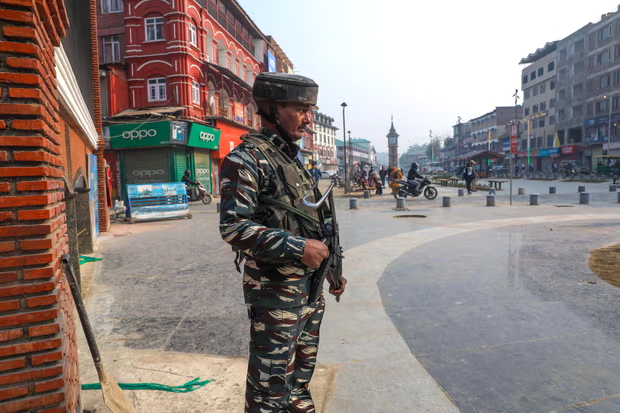
Security beefed up in Jammu and Kashmir

‘We both are victims of Islamic terror’


In the aftermath, the Indian internet factcheckers AltNews and Boom began to observe a flood of disinformation targeting Palestine pushed out by Indian social media accounts, which included fake stories about atrocities committed by Palestinians and Hamas that were shared sometimes millions of times, and often using the conflict to push the same Islamophobic narrative that has been used regularly to demonise India’s Muslim population since the BJP came to power.

BJP-associated Facebook groups also began to push the message that Hamas represented the same Muslim threat facing India in the troubled, majority-Muslim region of Kashmir and Palestinians were sweepingly branded as jihadis.

Messages widely forwarded on WhatsApp urged Hindus to arm themselves and boycott Muslims, reading: “In the future, India could also face conspiracies and attacks like Israel. The possibility of Hindu women facing cruelty cannot be ruled out.”

The same narrative also made its way on to some of India’s most inflammatory news channels, with Arnab Goswami, the rightwing firebrand presenter on India’s Republic TV, telling viewers: “The same radical jihadist Islamist terrorist thinking that Israel is a victim of, we are a victim of as well … Israel is fighting this war on behalf of all of us.”


Some Hindu nationalist groups appeared to heed this as a call to arms. Last week, groups gathered outside the Israeli embassy in Delhi, offering their services to fight Hamas. Among them was Vishnu Gupta, 58, the national president of Hindu Sena, who said he was among 200 men who had volunteered for the Israeli army, adding that his confidence had been boosted by Modi.


“We both are victims of Islamic terror, that is why we have been supporting Israel from the beginning,” said Gupta. “Just like Jerusalem was overtaken by Muslims, holy places in India were also invaded by Muslims. Like Hamas, there are militants from Kashmir supported by Pakistan who would carry terror attacks across India. The only fortunate thing about us is that we are not in the minority.”


Historically, India had a very different relationship with Israel. Its first prime minister, Jawaharlal Nehru, and the influential Indian freedom fighter Mahatma Gandhi had opposed the creation of an Israeli state, fearing it would disfranchise Palestinians, and India voted against it at the UN.


India was the first non-Arab country to recognise the Palestine Liberation Organisation (PLO) as the legitimate representative of Palestine in the 1970s, giving the group full diplomatic status in the 1980s and inviting PLO’s long-serving leader Yasser Arafat to visit several times, and consistently maintained a pro-Palestine position at the UN. 


It was only after the PLO began a dialogue with Israel, and as US pressure began to build, that India finally established diplomatic ties with Israel in 1992.


Potential friction with India’s valuable Gulf partners


A turning point came in 1999 when India went to war with Pakistan and Israel proved willing to provide arms and ammunition. It was the beginning of a defence relationship that has grown exponentially. India buys about $2bn-worth of arms from Israel every year – its largest arms supplier after Russia – and accounts for 46% of Israel’s overall weapons exports.

But it was the election of Modi that marked a fundamental sea change. While previous governments had kept their dealings with Israel largely quiet, due to concerns of alienating foreign allies and its own vast Muslim population, Modi’s Hindu nationalist BJP government had very different priorities.

In 2017, Modi became the first Indian prime minister to visit Israel, which was reciprocated months later when Netanyahu travelled to Delhi. The images of the pair strolling barefoot with their trousers rolled up along Haifa beach in Tel Aviv, described by Indian media at the time as a “budding bromance”, were later used by both leaders in campaign material.

Essa said: “The narrative they were pushing was clear: that India and Israel are these ancient civilisations that had been derailed by outsiders – which means Muslims – and their leaders have come together, like long-lost brothers, to fulfil their destiny.”

The ideological alignment between the two leaders was certainly more apparent than in the past. The BJP’s ideological forefathers, and its rank and file today, have long regarded Israel as a model for the religious nationalist state, referred to as the Hindu Rashtra, that the Hindu rightwing in India hope to establish.


While Modi was also the first Indian prime minister to visit Ramallah in Palestine, much of the focus of his government has been on strengthening ties with Israel, be it through defence, culture, agriculture and even film-making. This year, Gautam Adani, the Indian billionaire businessman seen to be close to Modi, paid $1.2bn to acquire the strategic Israeli port of Haifa.


Nonetheless, Modi’s foreign policy has also overseen a transformation in ties with Arab Gulf countries including Saudi Arabia, the United Arab Emirates and Qatar, which has been of great financial benefit to India and laid the foundation for a groundbreaking India-Middle East economic trade corridor, running all the way to Europe, which was announced at the G20 forum for international economic cooperation this year but has yet to be built.


While the Gulf has also been working to normalise ties with Israel, analysts said should the Israeli-Hamas conflict continue to escalate, it was likely that India would quieten its pro-Israeli stance to prevent friction with its valuable Gulf partners.


Alvite Singh Ningthoujam, a fellow at Middle East Institute in Delhi, said since Modi’s initial comments, there had been a “calculated silence” from the government.

“While Modi is comfortable making statements that condemn cross-border terrorism, if this conflict escalates, and other countries that his government has relationships with get involved, it will be a big test for India,” he said.  (The Guardian)