Sunday, May 1, 2016

How to Curb Money Laundering? Modi Govt. seems to be taking a Methodical but Slow approach


Biju Janata Dal (BJD) floor leader in the Lok Sabha Bhartruhari Mahtab is one of my favourite lawmakers in Parliament. He raised a pertinent question in the lower house of Parliament on April 29, 2016 during question hour and wanted to know if in the wake of reports from SIT and other agencies, the government is proposing any changes in the law to keep an eye on tax evaders.

"....has SIT suggested what new law is to be enacted which will minimise the creation of black money in the country?" he asked.

A smart question and was handled with equal smartness by the Minister of State for Finance, Jayant Sinha – who actually skipped a direct reply. The reasons are many. But the government seems to have started work on this front as well.

In an attempt to prevent ill-gotten money from leaving the country’s shores, the government has asked its economic offences agencies to study the loopholes in the country’s banking laws, according to well-informed sources. With the quantum of black money held by Indians abroad variously estimated at between $466 billion and $1.4 trillion, the idea is to get a fix on how the network operates. 
                                 
Pervading secrecy, cut-throat competition among private and international banks, along with the organised crime models, have all resulted in giving a boost to money laundering both in India and abroad. A large number of foreign and private banks operate in secrecy. In Switzerland and Cyprus, dirty money is often pumped to their financial system via organised channels. Privacy is at the core of the functioning of private banks. So the government is left with few options when it wants to crack down on leads. 

"There is a competition, a number of foreign and private banks also operate in secrecy and jurisdictions like Switzerland. Often dirty money is pumped in financial systems through organised channels, deposit wires and unlawful proceeds," a source said.

Preliminary reports from agencies and departments under the union finance ministry have already reported  that private banks in good number of case studies have failed to show that they have "intimate knowledge" of their clients.

"A multiple layers of secrecy help clients to mask their accounts and transactions," the source said.

A simultaneous directives from the Home ministry and Finance ministry was given to various security agencies last year to study these offences. The departments like Enforcement Directorate, Serious Fraud Investigation Office (SFIO) and Customs and other Indian agencies were asked to study whether and how "pervading secrecy" in the operations of private and foreign banks have contributed to promote money laundering at some quarters.

Snap: Nirmal Deb(Facebook)

Subsequently all these agencies and departments are trying to figure out how some of the existing "weaknesses" in laws are being used by unscrupulous elements for such activities. 
"Private banking industry's basic functioning is marred by a culture of pervading secrecy. And government has fewer options to crack some of the information," a preliminary finding revealed. The sources explain that money laundering involves multiple transactions to disguise the source of financial assets. 

Moreover, money laundering offers challenges to law enforcing agencies both in India and overseas countries as it is "group activity" like organised crime and caters to long term interest and is "most often continuing in nature" with far off and deep reach. These make task of trailing these money very difficult more so in a world of cut throat competition as banks face dual pressures of rivalry and expansion and thus the banks cannot impose strong anti-money laundering rules on their clients.

In this context, another key central government agency in a 100-page report to the government has said that after September 2001 while international response to underground economy has been well coordinated, many countries are still clueless about what to do with off-shore banking havens in Cyprus, Cayman Islands and the Netherlands Antilles. The law enforcing agencies, sources admit, are also confronted with a herculean challenge in the form of cyber mafia. "The power of internet has made it too easy for offences like phishing to flourish," the source said.

The Reserve Bank of India (RBI) has also been roped in to investigate. Photo: Reuters)

Officials said a comprehensive study can also help in understanding how the flow of such money can be curbed while also equipping banks to have a strong anti-money laundering rules for clients, backed by law.
During the latest US visit of Finance Minister Arun Jaitley, coordination and cooperation among various countries to curb money laundering was at the core of his itinerary. Even at the special session of the US on drugs, he dwelt on the nexus between illicit money, drugs and terrorism. India also wants to give inputs to the Organisation of Economic Cooperation and Development to be able to come up with objective criteria soon to identify jurisdictions that did not cooperate towards a transparent financial system.

The setting up of Serious Fraud Investigation Office (SFIO) was a crucial step in 2003 during the Vajpayee government. Functioning under the ministry of company affairs, SFIO has done quite a good job vis-a-vis shell companies those are floated only to route fund without doing realtime business. 

In fact the SIT on black money set up by the Modi government in May 2014 could detect with the help of SFIO that over 300 addresses show at least 20 companies "operating from the same place". Over 77,000 companies were found violating the norms relating to directorship.

Minister of State for Finance Jayant Sinha informed members that the appointment of a Special Investigation Team (SIT) by the National Democratic Alliance (NDA) government in 2014 had helped in the purpose of tracking black money both in the country and outside. "SIT is doing a commendable job," he said, adding that recommendations of the SIT had helped investigating agencies and the government, especially with regard to black money stashed overseas. "We have received a wide set of recommendations from the SIT. The recommendations have been included and efforts have been undertaken through the Black Money (Undisclosed Foreign Income and Assets) and Imposition of Tax Act, which was passed in this august House. This has resulted in a certain level of compliance. "There has been a series of investigations and it is because of disclosures which we got through HSBC as well as through the International Committee of Journalists and most recent has been the Panama Papers, as finance minister has indicated, notices have already been sent out," Sinha said.

He said as far as domestic black money is concerned, a number of suggestions have been provided there including the disclosure of PAN card for transactions of Rs.2 lakh, restrictions on real estate, and so on which have been implemented.
(ends)
                                                        
                                         The move come after over 100 organisations were linked to off-shore accounts in the ‘Panama Papers’ leak. (Photo: Reuters)                                    


Saturday, April 23, 2016

Uttarakhand politico-legal battle: And media's very own Crisis of Credibility

The World in Photos This Week
Photo: Foreign Policy website
      What is journalism, what does it mean in our lives? Why should it mean anything?


On this backdrop let us take a closer view at Uttarakhand development, the fierce legal battle and the media coverage.

The over enthusiasm among sickular brigade has yet again led us to sub-standard journalism. The question is immaterial as the enthusiasm is linked to Narendra Modi bashing.
 How?
That Uttarakhand High Court verdict was harsh on Narendra Modi made all and sundry happy...especially Namo baiters. And hence the excitement prevailed ---- for them high court verdict was equivalent to sending Modi to gallows.
Even the likes of Subramanian Swamy got an opportunity and lashed out at Attorney General Mukul Rohtagi, no friend of Swamy obviously!
So immature reporting surfaced – almost in the manner 19-year-old Kanhaiya Kumar became a threat to India’s incumbent prime minister! Harish Rawat became instantly a chief minister. Even popular media organizations, supposed to thrive on credibility the vital C of A,B,C of journalism started addressing Harish Rawat as chief minister.

That Rawat has been a good host to the union meet of a news organization workers is another issue to ponder over.

My perception is that the quick conclusion that Harish Rawat 'returns' as CM interpretation itself was wrong. My logic is not based on any scholarly knowledge on legal matters. It was only logical. Rawat could return in official sense only after revokation of President’s Rule by President and there should have been a Governor's order. 
The argument is again logical. Court is only a judiciary, a key pillar of democracy and executive powers are with President and Governor – and a popular government in office – incidentally that’s headed by Narendra Modi.
Rawat himself walked into a trap of media hype and ill-advice by master in that art – Kapil Sibal. To refresh memories, Sibal as the union minister had threatened “we can rein in” Baba Ramdev theory and poor P Chidambaram implemented it. The result is 2014 electoral drubbing – in the ultimate.

But artful self-obsessed intellectuals of national capital do not learn any lesson. Sibal is one of them who even takes credit for losing a battle. So his advice along with Ambika Soni to otherwise innocuous Harish Rawat, the "hill man", was to preside over the reins of power. It is altogether the Governor should not have allowed such a "cabinet meeting". It remains to be found whether Chief Secretary took an approval from the Raj Bhavan before rolling out the red carpet for Rawat's "cabinet meetings". Incidentally, the Congress enthusiasm was so much that they took two cabinet sittings.
A perfect bus!

Worse part is Rawat presided cabinet meetings even without written order from the court. Should not the chief secretary attract disciplinary actions?
By interpretation that high court order was good enough to take charge – my case is, if I win a case against my brother--- the land becomes mine.....is not absurd” ....The court order actually only PAVES MY WAY TO GET THE LAND.

So correct reporting would have been: HC order paves the way for return of Rawat.
But the game was elsewhere -- that was in excitement that Modi has been thrashed by the court orders. Hence, secular intellectuals went ballistic. We forgot courts only have recommendation power. Executives have the liberty to challenge it in higher court or abide without resisting.
Poor standard of English journalism prevailed. Even a former MP Kuldip Nayyar was wrong, I am afraid.
 I spoke to him and filed a story, wherein he told me:
"The ruling makes it clear that Harish Rawat was wrongly removed as chief minister. His position as the leader of the house and the chief minister has been restored now," Nayyar said.


But some other experts I spoke to were reasonable. They were modest guys -- unlike Somnath Chatterjee variety self-righteous intellectuals or Arvind Kejriwal's wisdom school.
Especially those inclined towards the Bharatiya Janata Party and the central government had disagreed on Rawat's status on Thursday (Aprril 21) "pending revocation" of the President's Rule.

 So, that Rawat called midnight cabinet meetings and took several decisions does not mean he had the right. Governor did not act. Actually he remained passively inactive --- this raises bonafide questions about his intentions. K K Paul, is a Congress appointee and so that means he too could be wrong. Why Modi government is soft pedling on replacing Paul, a former Delhi police commissioner, is another puzzle.

The observation made during the hearing in the Supreme Court, by Justice Shiva Kirti Singh: “If I were the High Court judge, I would have made my judgment operational only after three or four days when it is signed and ready. It is more on propriety than legality. Governance of a state cannot be left in the lurch” – is actually a very powerful message. 

This should not be ignored.

ends

Tuesday, April 12, 2016

Why BJP faces uphill task in "pro-communists" Bengal?

For Bharatiya Janata Party (BJP) and its right wing politics of neo-nationalism, liberal economic policies and even pro-Hindutva religious slant, poll-bound West Bengal offers more than a Herculean challenge and jigsaw puzzle.

Even as the saffron party's electoral fortune surged ahead in 2014 Lok Sabha polls, slowly the party leaders are realising that at several quarters in the on-going assembly polls, more than the organisational weaknesses, the saffron party faces "basic ideological barriers".

Culturally and intellectually, Bengali voters are "essentially pro-Left", say those in the know of things. "The fact that Bengali voters and even other citizens in the state remained pro-Left ideologically, culturally and intellectually it  make things difficult for BJP in West Bengal unlike neighbouring Assam where the pro-Hindutva slant actually always had acceptance among upper caste Assamese voters," says one leader.

                               Tough for rightist party like BJP in largely Left-leaning Bengal


Thus the saffron party poll managers believe that while the party is near the striking distance in Assam, despite all efforts to woo the voters as against the non-performance of the Left and even Mamata Banerjee-headed Trinamool Congress, BJP finds the going tough in terms of winning over seats. In Assam, upper caste Hindus could relate to Brahminical appeal of the RSS and the BJP unlike in West Bengal where "ironically upper caste Bhadrolok" have been associated with the Marxist politics for decades now.

In fact, other than BJP leaders, even Janata Dal (United) leader Sharad Yadav, a former associate of BJP and onetime convener of NDA, says, "Indian leftists cold not make much headway in northern states as they could not appeal to backward and lower caste groups. Thus these lesser privileged communities flocked to the socialists block".

In the Bengal context, even the state Governor K.N. Tripathi told a seminar in February this year in Kolkata that while higher educational institutions are becoming hubs of politics, "the role of the students organisations should be changed. It is to inform and to make the students aware through lawful means. This is a factor which needs to be taken care for the larger interest of the society". 

Many see Governor's remarks this as commentary on violence-oriented political culture in West Bengal -- which again largely draws inspiration from communists way of looking at things. Trinamool MP and former union Minister Sishir Adhikari has merits in his analysis: "Under Marxists misrule and when Singur and Nandigram happened, people of Bengal saw us as the genuine followers of communists ideology. That was the turning point of Bengal.
Being New Left: Advantage Mamata

This was when, he pointed out, Trinamool leaders started mocking CPI-M leaders as "pseudo followers" of Karl Marx.
Still lacking mass appeal
"This actually helped the Trinamool to get votes. Slowly people in Maoist-hit areas developed courage and faith in democracy," he said.Thus, when Mamata Banerjee played to the hilt her pro-farmers card against the failed industrialisation attempts of the Left, she appeared to the people as a more genuine political leader than the Marxists.

The result was Maoism almost came to end by 2011-12 especially after Maoist leader Mallojula Koteshwar Rao alias Kishenji died," says Adhikari.

A section of Trinamool leaders also maintain that the Naxal movement had survived on a very weak footing in Bengal's Junglemahal region the then Left government did not allow “any political opposition".
"That was a dangerous trend for a democracy. As a result people’s faith in democracy eroded," said another leader.

This perhaps also made Leftists cadres task easier when enmasse they decided to opt for Didi and her party Trinamool Congress to abandon Marxism.

"Didi's (Mamata Banerjee's) image as a pro-poor leader with a rubber chappal and cotton sari actually challenged Leftits' image of 'sarba-hara (all for sacrifices). But today people know it well while Didi (Mamata) moves around in chappals, her party colleagues are no less than crorepatis (rich)," says BJP's Asansol MP and union minister Babul Supriyo.  

By its inherent contradictions both in economic and social contexts, BJP lacks the leftists slant. Thus though campaigning aggressively, the general apprehension inBengal BJP leaders and poll managers is they may not win many seats as such.

Higher vote share for BJP in 2014 Lok Sabha polls actually helped CPI(M) candidates in many constituencies.


For instance in Raiganj parliamentary seat, CPI(M) nominee Mohammed Salim defeated Deepa Dasmunshi of Congress by a margin of merely 1634  votes, where in BJP candidate Nimu Bhowmick had polled over 2 lakh votes.

Thursday, March 31, 2016

Namo's Cooperative Federalism - Biggest casualty of President's Rule in Uttarakhand


The state of Uttarakhand was placed under President's Rule. The Modi government has done it within two months since it dismissed and imposed central rule in Arunachal Pradesh on January 26. The imposition of President's Rule dismissing Harish Rawat regime in Dehradun is yet another addition to the catalogue of constitutional steps/sins - as one sees it - committed in exercise of the Article 356.

The provisions of the Article 356 - giving sweeping powers to the central government - are essentially aimed at restoring constitutional propriety after breakdown of the same, said V R Krishna Iyer once. 

And certainly it cannot be used to settle partisan scores.
But the obvious actions from the Modi government in two Congress-ruled states suggest New Delhi has tried to trample over the state autonomy. 

 By doing so, Modi has followed the footsteps of the Congress reign while in power. Yet, he had promised a different kind of polity.
Abuse of Article 356, though, is nothing new in Indian politics. A few BJP leaders have tried to build up an argument that the Congress had no business to talk about constitutional decorum as the grand old party had several times dismissed non-Congress governments across the country.
"Congress is forgetting how many state governments it has dismissed in the last 60 years," Kailash Vijayvargiya, BJP leader, said.
In 1992-93, the PV Narasimha Rao government at the Centre dismissed four BJP governments – in Uttar Pradesh, Madhya Pradesh, Rajasthan and Himachal Pradesh following the demolition of Babri Masjid on 6 December.
After the Rao regime dismissed the Nagaland government led by Vamuzo in 1992, the chief minister said that the imposition of President’s Rule did not surprise him. “After all, the Congress has always considered itself as imperial power and treated the states as colonies,” the late Vamuzo had said. In 2005, during Manmohan Singh’s regime, Goa Chief Minister Manohor Parrikar – now the Defence Minister – was dismissed by Governor SC Jamir.
Incidentally in 1990, Jamir, then Nagaland Chief Minister, was himself dismissed by Governor MM Thomas after 12 ruling Congress legislators defected from the Congress camp.
Like Rawat, Jamir had demanded trial of strength in the assembly and had managed the backing of the Speaker, late TN Ngullie.
However, Governor Thomas, during the VP Singh regime at the Centre, did not summon the assembly and had even declined to meet two Congress observers, Rajesh Pilot and SS Ahluwalia, saying the views of Congress MPs were not required on a political situation in Nagaland.                                                           
 Uttarakhand Chief Minister Harish Rawat addresses a press conference in Dehradun. (Photo: IANS)

Even government led by hardcore socialist Chandrashekhar was no different. It had dismissed DMK ministry of Karunanidhi despite no adverse reports from the state Governor S S Barnala in 1990 when Chandrashekhar survived on Rajiv Gandhi's support and the latter (Rajiv) wanted to win over powerful Jayalalitha in the southern state.

Ironically, Congress party is now at the receiving end of imperial character of the central government. "Murder of democracy" being the refrain! These only bring us to the debate on the merits of Governor’s office and certain discretionary powers vested in him. Secondly, whether Article 356-357 that allows Centre the power to dismiss the state government or dissolve a state assembly or both should be deleted also needs a closer look.

A clear vindictiveness if not pettiness was the hallmark of the final decision by the BJP-led NDA on March 26-27 which not long ago has been screaming about "cooperative federalism". Logic is a major casualty in the process as also the implications of developments in Arunachal and Uttarakhand must be weighed in properly.

Not only the Modi Sarkar has put the other Congress governments like Manipur, Himachal Pradesh, Meghalaya and Karnataka on notice; it also continues with a bad precedent started by Congress long ago.
Modi-Rajnath ought to remember their election pledge

Friday, March 18, 2016

Neta-Babu nexus: Politicisation of public services - A Challenge


“If you believe the doctors, nothing is wholesome; if you believe the theologians, nothing is innocent. If you believe the soldiers, nothing is safe”. – Lord Salisbury

So what about Indian bureaucracy and more precisely the now famous Neta-Babu nexus. What happens if you trust them?

The instances of former Delhi police commissioner B S Bassi allegedly playing into political tune or former top babus like G.K Pillai coming forward turning the tables on Prime Minister Narendra Modi's known detractor 
P Chidambaram vis-a-vis Ishrat Jahan case is a point in case," he says.

The political class seems to agree about the rot.
If G K Pillai had an issue with the affidavit on Ishrat case, he should have complained then, said many of them.

In 2011, a bizarre episode reflecting muscle-flexing by bureaucracy had come to light when a parliamentary panel probing the 2G scam found that former Telecom Secretary A. V. Gokak had "overruled" then Prime Minister I K Gujral in 1997 and referred the study on licensee fees to other fora instead of the Telecom Regulatory Authority of India (TRAI) as directed by the then prime minister.
"This was a major lacuna. This should not have happened. Prime Minister is the highest authority and any order from him should have been implemented in letter and spirit," then Joint Parliamentary Committee chairman P C Chako had said.

                                                   
Bureaucrats most often understand politicians and the factors those make or mar the political class better than many politicians themselves do. But Indian bureaucracy is also known as a class in itself for its efficacy in concealing their own thoughts. Post-retirement and in certain gubernatorial assignments, they do open up. 

I have been reading a new book 'Safeguarding India - Essays on Governance and Security' by N. N. Vohra, a former Home Secretary in the central government and incumbent Jammu and Kashmir Governor. It makes a few good points. 

Probably created few decades back, the 'Neta-Babu' nexus as an expression has a polemic sting. Therefore the chapter in the book ‘The Rustling Steel Frame’ obviously makes interesting read. 

The pages talk about “extra-constitutional pulls and pressures” and how political interference has “negated the scope of orderly functioning”. The book, however, does not make any big revelation or breaking news as the buzz word these days is. But it goes without saying that the bureaucrat-turned-author had certain access to key issues and policy lapses concerning national security. These would thus add to the merits of the book.

All these coming from a former Home Secretary to the government of India and also someone who has in 1990s authored a report on criminal-politicians nexus make the book relevant in the contemporary setting. It is a collection of essays penned by Vohra and published in country’s leading newspapers and periodicals from 1996-97 onward and a few select lectures delivered by him on important subjects.

"The politicisation of public services, with money and muscle power playing an increasing role, has negated the scope of orderly functioning," says the book.
"To remain in power at any cost, the political executives consciously select pliable officers," says Vohra, who in 1993 authored the famous Vohra (Committee) Report on the nexus among criminals, politicians and bureaucrats in India.
"Over the years, governance through known policies, systems, rules and procedures has been vitiated by political interference and all kinds of extra-constitutional pulls and pressure," says the book (published by Harper Collins Publishers).

Serving officials, on the condition of anonymity, agree to most of what Vohra says with a few stating that mostly the political class and hidden ambitions of the babus are to be blamed for the loss of credibility of Indian steel frame.
The latest instances suggest politicians of all hues believe in using and abusing the bureaucracy, said an office-bearer of IAS Association in West Bengal.
Governance: A mirage?

On this occasion one remembers, former Chief Election Commissioner T N Seshan, known for his maverick style and who had acidly coined a phrase "I am sorry" for the abbreviation of IAS.
But complexities in Neta-Babu relations is nothing new as there have been several such instances of bonhomie and at times political arm twisting as well as kowtowing of the steel frame in front of the political class. Under Manmohan Singh, several babus and former military men thrived in post-retirement careers.
Top brass in intelligence M K Narayanan was accommodated first as National Security Advisor and then as Governor of West Bengal. The likes of P C Haldar and R S Pandey were assigned as negotiators to deal with ultras in the northeast.

But as weather for UPA dispensation looked cloudy, Pandey joined BJP. So did R K Singh, another former Home Secretary, and now MP. Mumbai former police commissioner Satya Pal Singh also is in the saffron party these days.  

Prime Minister Narendra Modi has his own opinion about bureaucracy. In fact, on March 3 during his reply to the debate on President Pranab Mukherjee's address to Parliament, he made terse remarks on babus in the Lok Sabha and said, "arbo-kharbo ka tankha ja raha hae (Crores are being given as salary of government servants)".

True, Indian bureaucracy, known for its huge numerical strengths and peculiarity in performance, has grown from 1,232 in 1951 to over 5,000 in 1996.
By 2011, according to officials in the Ministry of Personnel, total sanctioned strength of IAS officers as on January 1 was 6,077 and of these 4,488 were in position, thereby making a shortage of 1,589.


The problems for babus mount once good work yields reprimand.
O P Sharma was appointed Governor of Nagaland by H D Deve Gowda government after the former Punjab cop fell out with Congress dispensation in his state.
"I know of former Punjab DGP O P Sharma who worked in tandem with KPS Gill to curb the spinal cord of Punjab militancy. But once government changed in the state, he was hounded out by the Brar government," says a Punjab cadre official.

In his book, Vohra does not deal with a single theme but good governance seems to a common thread for all the articles as in the preface he talks about the quality of governance and the need to evolve “courses of action” for dealing with problems arising from the failures of governance and security management.

The essay ‘Beyond Pokhran and Chagai’ originally published in August 1998 – about five months after nuclear tests by both India and Pakistan – make an impatient plea for resolution of outstanding problems between the two countries.

“It will indeed be a historical blunder if, compelled by the nuclear capability syndrome, they (both India and Pakistan) further delay devoting attention to the resolution of problems which stand between two countries,” he writes.  
Blogger 
Hopefully the cautioning lines Vohra draws should ring alarm bells in the ears of those who matter.

That Vohra himself is an incumbent Governor of a key state like Jammu and Kashmir only makes it obvious that he has the ears of those who are at the helm of affairs in the country. The important point is, are they all listening?

(ends) 

Monday, March 14, 2016

Take Away from World Fest: Emergence of India as a Soft Power


The polarization of India’s intellectual class is so deep that it is difficult to express an opinion and that would still be considered an objective one. If one writes with a few laudatory words and phrases while trying to pour in an element of understanding, he is in the danger of being called a communal or bought over by Narendra Modi’s charm and machinations. 
On the other hand, if one takes a critical stand as against his government’s active cooperation with the just concluded Art of Living’s World Culture Festival, one cab easily accused of distortion and charged with trying to lampoon at own culture. 
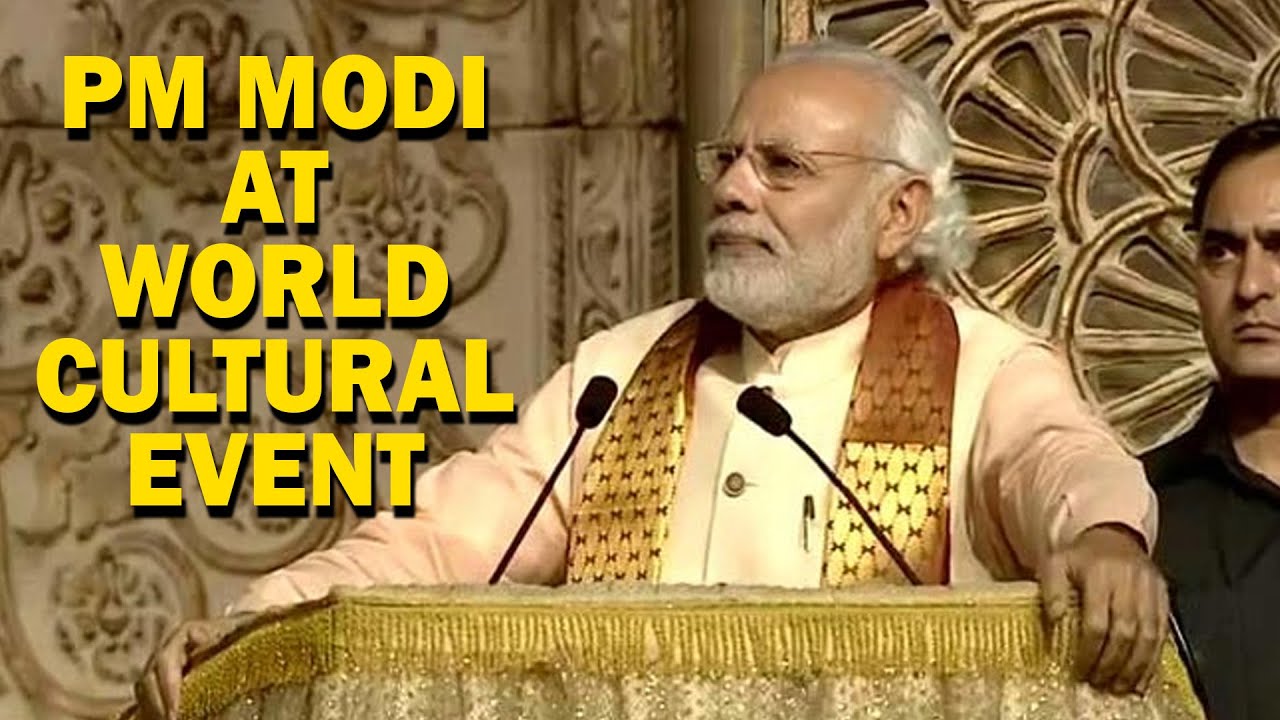
Well, none other than Prime Minister Narendra Modi gave credence to this argument when he told the inaugural session of Sri Sri Ravi Shankar’s cultural extravaganza that "We can make contribution (of India’s soft power) only when we ourselves feel proud of our culture. But if we continue to curse ourselves, then how will the world look towards us.The world is not only united by concerns of economic growth, but also by human values and India can play a vital role in it".
                             
As one ponders about analyzing the three-day fest, a western maxim comes in mind, “Obedient sheep are not known for their creativity”.
Both PM Modi and Sri Sri Ravi Shankar, one likes them or not, defy definitions and in their own wisdom declined to play obedient sheep. This shakes the foundation of the established Indian intelligentsia’s faith in itself. A mixture of distorted principles of Marxism, Nehruvian secularism and the western style of democracy pose a kind of challenge for guiding India’s future.
Actually, we stand with neither of these virtues. To top it, an emphasis on individual liberties and often in an unreasonable manner has been perhaps also playing little part or as a negative catalysis in India’s transformation. 
At the end of three-day event, Sri Sri Ravi Shankar’s cultural bonanza has to be admitted as some kind of success as it has evoked certain positive vibes at least about the values and importance of unification of the various civilizations of the world. It may not achieve any miracle though.
                             
British Prime Minister David Cameron invited Ravi Shankar to address the House of Commons and sent in a powerful message saying, "People say that no one can change the world but Sri Sri had made a good start. We are seeing a ray of hope.
The Australian Prime Minister Malcolm Turnbull, who could not attend, invited Sri Sri through his message hold the next festival in his country while Colombia's President Juan Manuel Santos also sent a message.
On the home front, brushing aside their political differences Arvind Kejriwal-led Aam Admi Party (AAP) and leaders from Modi’s Bharatiya Janata Party (BJP) shared dais.
What do these laudatory words and actions suggest?
One, amid the big debate the media had plunged into to the support pro-environment brigade and discredit Sri Sri Ravi Shankar’s show was just not doing the job effectively. They were far from telling the whole truth. Or they did not know that Prime Minister was backing Sri Sri to the hilt? 
Secondly, a question remains whether they played into anti-Modi and anti-Ravi Shankar lobbies and thus deliberately or otherwise became a party to spread a message that the festival would come a cropper. And thirdly, the basics, has media lost its job of playing a mirror’s role and instead fall prey to interpreative and sensationalism in journalism.
Next question that demands scrutiny is: what’s the real power of India getting its hold as a “soft power” in global context?
Prime Minister Modi had merits in his argument when he told the gathering at sprawling Yamuna bank that world unity is not solely dependent on economic necessities. We know it does not depend on the mite of military vis-à-vis the need to fight global terror, as the United States has often batted for. 
Blogger's daughter: Extreme left at World Fest

In fact, Modi’s stress on “human values” would be a lasting India’s strength and in it India can actually manage to enlist the support of other oriental powers including China.
This could mean – time to wake up the foreign policy community to the realization that in days to come the traditional diplomatic game could change fundamentally. On the Asian front, it will give a message to Pakistan that civilisational and cultural prisms too could prove to be effective tools in the changed world order.
So what’s Sri Sri Ravi Shankar upto? 
The big picture message is - the international game can be no longer about pushing a single-agenda item. Soft power game also means persuasive diplomacy. It may be out of the box, but not something out of the blue.  

Life is often like standing in the dusk. It is all about optimism. Optimism leads to patience. The storm would pass off eventually no matter, how long it is. This is the take away from Ravi Shankar’s fest. That’s the essence of India’s civilisational “soft power” strength.
(ends) 

"Many RSS leaders are now money-rich and also time-rich" ::::: Lal Darwaja ... location Ahmedabad ::: Discussions over 'late night chai' .... "A combination of many factors work in favour of image building for 'the Modi Model'

My trip to Gujarat last week - as usual with most travels - offered some fascinating experience.  I got a chance meeting with few individual...